
Davos 2026: Churchill, Marshall, Carney – Between Myth and Reality
GLOBAL AFFAIRS, POLITICAL ECONOMY, GOVERNANCE & INSTITUTIONSPOLITICS
Chaifry
1/23/20267 min read
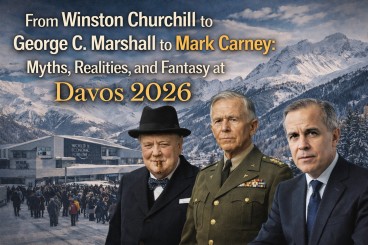
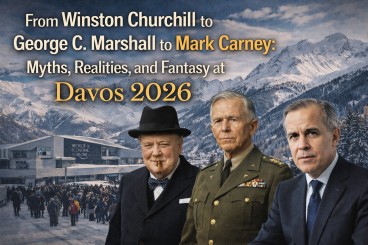
From Winston Churchill to George C. Marshall to Mark Carney: Myths, Realities, and Fantasy at Davos 2026
Fragmentation, ‘A Spirit of Dialogue,’ and why unity keeps failing when stakeholders lack mandate, capacity, and accountability
Executive summary
Davos 2026 is staged under the World Economic Forum’s theme “A Spirit of Dialogue,” with record levels of political and business participation. At the same time, the Forum’s own risk work describes an “Age of Competition” where geoeconomic confrontation leads the near-term risk ranking,
intertwined with societal polarization, mis- and disinformation, and rising concern about adverse outcomes of AI and cyber insecurity. This creates Davos’ defining contradiction: dialogue is promoted as a solution while the operating environment rewards fragmentation.
This article uses three leadership archetypes—Winston Churchill, George C. Marshall, and Mark Carney—to separate myth from reality:
“Churchill” is often invoked as a shortcut to unity through moral clarity and rhetoric, but his real lesson is coalition maintenance under constraint.
“Marshall” is used as a synonym for “a big plan,” but the Marshall Plan worked because money was paired with architecture, coordination, and institutional design.
“Carney” stands for technocratic competence in crisis, but Davos 2026 shows credibility cannot neutralize coercion when economics becomes geopolitics (tariffs, sanctions, industrial policy).
The conclusion is practical: stop selling “unity” as a feeling. Build minimum viable unity as a set of enforceable constraints—small, measurable agreements on trade guardrails, AI and cyber incident protocols, and climate finance pipelines—plus a stakeholder fitness test that screens out performative coalitions.
1. Davos 2026: what “A Spirit of Dialogue” is trying to do—and why it’s struggling
The WEF’s framing for Davos 2026 is explicit: dialogue is not a luxury; it’s necessary. The Annual Meeting is presented as an “impartial platform” where diverging actors can exchange views and “turn shared understanding into action,” at a moment of rising fragmentation and rapid technological change.
The numbers underline the ambition. WEF notes close to 3,000 participants from over 130 countries, with unusually high political attendance and large representation from CEOs, chairs, and technology pioneers. If you only read the press release, Davos looks like a reset button.
Now place that against WEF’s own risk landscape. In the Global Risks Report 2026 Chapter 1, geoeconomic confrontation rises to the top of the near-term list, while societal polarization and mis- and disinformation remain persistent drivers of instability.
A separate WEF explainer on 2026 risks reinforces that polarization is a stable, high-ranking feature across time horizons, and that AI and cyber risks are rising in relevance. So Davos 2026 has a built-in friction:
The event needs cooperation to be credible.
The risk environment rewards defection, leverage, and strategic ambiguity.
That is why Davos is best understood as a marketplace of narratives. The room creates shared language. Whether that language becomes outcomes depends on mandate, capacity, and enforcement.
2. Churchill at Davos: the myth of unity through a single voice
The Churchill myth is neat and emotionally satisfying: a leader sees danger clearly, refuses appeasement, and uses moral clarity to unify society. When modern commentators say “we need a Churchill,” they usually mean “we need someone who can cut through polarization.”
But Churchill’s real lesson is not theatre. It’s coalition work under constraint. Churchill’s effectiveness during WWII was grounded in the existence of state capacity and wartime institutions able to translate resolve into action: industry, logistics, coordination with allies, civil defense, and war finance. The rhetoric mattered because a machine existed to implement what the rhetoric demanded. Davos 2026 tries to borrow Churchill’s aura while operating in the opposite conditions:
fractured information ecosystems,
lower trust in institutions,
and high polarization amplified by attention platforms.
This is where search behavior becomes relevant in a practical way. Online audiences are drawn to high-salience terms—polarization, protests, civil unrest, demonstrations, riots, and conflict narratives. Media ecosystems (including polarizing outlets such as Fox News in the U.S. and equivalents elsewhere) can turn governance debates into identity battles. The end result is that “unity through a speech” becomes harder to achieve, even when the policy case is strong. The Churchill take-away for Davos is blunt: unity is manufactured through institutions, not discovered through messaging. If Davos wants Churchill-level social cohesion, it must build systems that restore shared facts and credible enforcement—not just improve rhetoric.
3. Marshall at Davos: the myth of “a plan” and why architecture beats announcements
Davos loves to say “we need a new Marshall Plan.” It is a tempting line because it implies a clean solution: big funding, big coordination, fast recovery. But the historical record matters. The Marshall Plan (European Recovery Program), authorized through the Economic Cooperation Act of 1948, ran across the late 1940s and early 1950s and involved around $13 billion (often cited as $13.3B appropriated over four years) in U.S. aid. What is frequently missed is the operational design: coordination mechanisms, rebuilding trade links, stabilizing finances, and institution building that made recovery and integration easier. The modern Davos version of “Marshall Plan” often skips three essentials:
Governance and verification: who audits and how frequently?
Incentive alignment: what makes partners stay in, when domestic politics shifts?
Consequences for non-performance: what happens when powerful actors defect?
This becomes more urgent in an “Age of Competition,” because the tools of economic policy have become tools of strategy: tariffs, export controls, sanctions, capital restrictions, and the weaponization of supply chains are now explicitly discussed as elements of geoeconomic confrontation. In that context, a “Marshall Plan for climate finance” or “Marshall Plan for AI governance” is meaningless unless it has enforcement, procurement integrity, and shared reporting that survives election cycles.
4. Carney at Davos: the technocrat myth meets coercive geopolitics
Mark Carney enters this story as the modern archetype of credibility: a crisis-tested economic manager with central banking experience. In 2026, Carney is also a political actor—reported widely as Canada’s prime minister—using Davos to argue that the “rules-based order” is rupturing and that middle powers must coordinate to resist coercion.
The news cycle matters because it shows the boundary of technocratic power. Coverage from AP and other outlets describes an open clash with U.S. President Donald Trump after Carney’s Davos speech, including Trump withdrawing an invitation tied to a new international “board of peace” concept. Whatever one thinks of the personalities, the structural point stands: when economics becomes geopolitics, credibility is not enough. The constraints are political and strategic, not only financial.
Carney’s lesson for Davos 2026:
competence still needs legitimacy,
legitimacy still needs domestic trust,
and trust is undermined by polarization, misinformation, and the feeling that “elite platforms” produce talk, not outcomes.
5. The “unfit stakeholder” problem: why Davos unity often evaporates
Davos is designed for multistakeholder collaboration—government, business, civil society, academia.
In theory, each brings something essential: mandate, capital, accountability, evidence. In practice, coalitions often fail because stakeholders are unfit for the job in one of four ways:
Unfit by mandate: They can speak, but they cannot commit resources or policy. They can announce, but cannot sign, fund, or legislate.
Unfit by capacity: They can promise reforms, but the delivery machine is missing: procurement, staffing, implementation systems, local capability.
Unfit by incentives: They benefit from ambiguity, delay, or conflict. If the reward is a headline, the rational strategy becomes announce, stall, blame.
Unfit by time horizon: Davos speaks in decades; politics operates in election cycles; markets operate in quarters. Without bridge mechanisms, the coalition breaks.
This year’s WEF content also shows how vocabulary itself becomes a signal. The Forum highlighted “trending terms” expected at Davos 2026—phrases like AI slop, electron gap, inclusive AI, quantum economy, suptech, minilateralism, resilience economics, “triple bubble,” “human advantage,” and “jobageddon.” These are not just buzzwords. They reflect the pressure points where governance struggles to keep up with technology and geopolitics.
6. A unity agenda that can survive 2026: minimum viable unity, not grand consensus
If “unity” means everyone agreeing on everything, it’s dead. If unity means reducing chaos through enforceable constraints, it’s still possible. Here is a practical Davos 2026 agenda that matches the risk landscape:
6.1 Guardrails on geoeconomic confrontation
escalation hotlines for sanctions/export controls
transparency triggers and review mechanisms
carve-outs for humanitarian and critical medical supply chains
pre-agreed dispute channels before tariff retaliation becomes automatic
Rationale: WEF ranks geoeconomic confrontation as the top near-term risk; guardrails reduce tail-risk.
6.2 Interoperable AI governance and cyber incident protocols
baseline safety evaluations for frontier systems
incident reporting norms across borders and sectors
red lines for attacks on critical infrastructure
shared definitions so “AI safety” isn’t marketing
Rationale: WEF flags adverse outcomes of AI technologies and cyber insecurity as rising concerns.
6.3 Climate finance that looks like infrastructure, not virtue
standard project-prep pipelines
blended finance that actually de-risks early-stage projects
comparable disclosure across markets
auditability for adaptation finance, not only mitigation
Rationale: credibility rises when money turns into projects with transparent procurement and timelines.
6.4 Resilience against misinformation and disinformation
transparency on state-linked influence campaigns
rapid correction networks and trusted local messengers
media literacy and civic education
platform accountability for political ads and synthetic media (deepfakes)
Rationale: WEF ranks mis- and disinformation and societal polarization as persistent destabilizers.
7. A stakeholder fitness test: the simplest way to reduce Davos theatre
Before announcing any coalition at Davos, apply a fitness screen:
Mandate: can this actor commit funding, policy, or enforcement?
Capacity: do they control systems that can deliver at scale?
Incentives: what would make them defect—and can we change that?
Time horizon: are commitments aligned with budgets and electoral cycles?
Verification: who measures progress, and how often, with what data?
Consequences: what happens if commitments are missed?
If a coalition cannot answer these, it’s not a unity coalition. It’s a networking cluster.
8. Bottom line
Churchill reminds us that unity is maintained under pressure, not declared. Marshall reminds us that money without architecture is waste. Carney reminds us that competence cannot neutralize coercion without legitimacy and coalitions. Davos 2026 can still matter—but only if it stops treating “dialogue” as the outcome and starts treating it as the entry fee. The real test of any Davos declaration is simple:
What changes next month—not next decade—and who is accountable when it doesn’t?
References and source links
WEF press release: Annual Meeting 2026 theme and participation figures (13 Jan 2026).
WEF Global Risks Report 2026, Chapter 1: ranking and explanation of geoeconomic confrontation and related risks.
WEF story: Top 10 risks in 2026 (two- and ten-year horizons).
WEF explainer: ‘Some of the trending terms you might hear at Davos 2026’ (AI slop, electron gap, minilateralism, etc.).
National Archives: Marshall Plan (Economic Cooperation Act of 1948) milestone document; notes $13.3B appropriated over four years.
Library of Congress exhibit overview: notes $13.3B appropriated for European recovery.
Encyclopaedia Britannica: Marshall Plan summary/significance and approximate $13B aid figure.
Associated Press: Carney fires back at Trump after Davos speech (Jan 2026).
Financial Times: Trump withdraws Carney invitation after Davos speech (Jan 2026).
The Guardian: coverage on Trump ‘board of peace’ and Carney ‘rupture’ speech framing (Jan 2026).
The Guardian: German chancellor warns of ‘great power politics’ at Davos 2026 (Jan 2026).