
India's Education Journey: Gurukuls to NEP 2020
EDUCATION POLICY
Chaifry
7/11/20264 min read
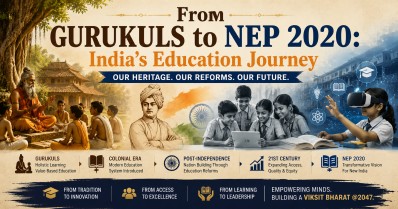
NITI Aayog. (2026). School Education System in India: Temporal Analysis and Policy Roadmap for Quality Enhancement. Education Division, NITI Aayog. Chapter I provides a compelling historical overview of school education in India, tracing its evolution from ancient Gurukuls rooted in holistic Vidya that integrated intellect, morality, and spirituality through colonial disruptions to post-independence rebuilding. It highlights landmark policies, including the Mudaliar Commission (1952), Kothari Commission (1964-66), National Policies on Education
(1968 and 1986), and the transformative NEP 2020, while emphasizing access, equity, quality, and the vision for Viksit Bharat @2047.
School Education in India
Today, India’s school education system is one of the largest on the planet, with 14.71 lakh schools serving over 24.69 crore students (UDISE+, 2024-25). Yet its true measure lies not in numbers, but in its ability to empower every child, especially girls from marginalized communities, to shape their destiny and the nation’s future. As India approaches its 100th year of Independence in 2047, the National Education Policy (NEP) 2020 offers a historic opportunity to turn centuries of aspiration into reality.
The Sacred Foundations: Ancient India’s Holistic Vision
Long before modern classrooms existed, education in India was a sacred pursuit. Vidya (knowledge) was revered as the ultimate companion, greater than friends, wealth, or pleasure. Ancient texts proclaimed: “Knowledge gives humility, humility gives worthiness, worthiness gives prosperity, prosperity gives righteousness, and righteousness gives lasting happiness.”
Gurukuls were not mere schools but communities of learning where students lived with their teachers, imbibing intellectual rigor, moral discipline, and spiritual insight through dialogue, observation, and experience. This system produced scholars, philosophers, and leaders who advanced mathematics, astronomy, medicine, and ethics. Education was inclusive in spirit, though access was often limited by social structures, a tension that would echo through history.
Colonial Rupture: Education as a Tool of Control
The arrival of British rule shattered this indigenous ecosystem. Lord Macaulay’s Minute on Education (1835) famously sought to create “a class of persons Indian in blood and colour, but English in taste, in opinions, in morals and in intellect.” English became the language of power, while vernacular traditions and experiential learning were sidelined.
This period created a deep cultural disconnect. Education shifted from holistic development to producing loyal clerks for the empire. The wounds of this rupture, alienation from roots and unequal access, would define post-independence challenges.
Rebuilding a Nation: Constitutional Dreams and Early Commissions
When India gained independence in 1947, it faced staggering illiteracy and inequality. The Constitution responded with vision. Article 45 directed the state to provide free and compulsory education for children up to age 14 by 1960. Though the deadline was missed, the commitment endured.
Swami Vivekananda’s words became a guiding mantra: “If the poor boy cannot come to education, education must go to him.” The Mudaliar Commission (1952) stressed mother-tongue instruction and teacher training. The landmark Kothari Commission (1964-66) declared that “India’s destiny is being made in its classrooms” and laid the intellectual foundation for a national policy.
Policies, Plans, and the Long March Toward Universalization
The Five-Year Plans prioritized expanding access, especially for girls and SC/ST communities. The National Policy on Education (1968) introduced the three-language formula and ambitious investment targets. The 1986 policy (revised 1992) brought practical momentum through Operation Blackboard, Navodaya Vidyalayas, and strengthened teacher education.
The Mid-Day Meal Scheme, launched in 1995, proved transformative. By addressing hunger, it dramatically improved enrollment and retention, particularly for girls who often bore the brunt of household responsibilities.
The new millennium accelerated progress. Sarva Shiksha Abhiyan (2001) and the Right to Education Act (2009) made education a justiciable fundamental right. Samagra Shiksha (2018) unified fragmented schemes into a coherent pre-primary to secondary framework, emphasizing equity, quality, and inclusion.
NEP 2020: A Bold Reimagination for the 21st Century
Against this backdrop, NEP 2020 emerged as the most ambitious reform since independence. It replaces the rigid 10+2 structure with a flexible 5+3+3+4 curricular framework aligned with developmental stages:
Foundational Stage (ages 3-8): Play-based learning and strong ECCE.
Preparatory, Middle, and Secondary Stages: Progressive development of critical thinking and skills.
Central to NEP is the NIPUN Bharat Mission, universal foundational literacy and numeracy by Grade 3. The policy champions mother-tongue instruction till at least Grade 5, reduced curriculum load, integration of vocational education from Grade 6, and holistic assessment through PARAKH.
Equity receives special attention through the Gender Inclusion Fund and targeted support for socio-economically disadvantaged groups (SEDGs), including girls, SC/ST, and children with disabilities. Teacher professionalism is elevated with the four-year integrated B.Ed. as the minimum qualification.
The Current Landscape: Gains, Gaps, and the Girl Child
As of 2024-25, India has achieved near-universal elementary enrollment. Girls’ participation has improved significantly thanks to schemes like Kasturba Gandhi Balika Vidyalayas, Beti Bachao Beti Padhao, and scholarships under Samagra Shiksha. Infrastructure has expanded, with toilets, drinking water, and digital tools now reaching more schools.
Yet significant challenges remain. The Annual Status of Education Report (ASER 2024) reveals that while enrollment is high, foundational learning outcomes still lag in many states. Dropout rates, though declining, continue to disproportionately affect girls in rural and northern regions due to poverty, early marriage, patriarchal norms, and safety concerns.
Despite sincere efforts by governments and NGOs, India still accounts for millions of out-of-school children, many of them girls. Implementation gaps, uneven state capacity, and insufficient focus on quality learning reveal that access alone is not enough. True transformation requires bridging the last mile, ensuring every girl not only enrolls but thrives, completes her education, and realizes her potential.
Toward 2030 and 2047: Turning Promise into Reality
Achieving Viksit Bharat demands urgent, coordinated action:
Prioritize Foundational Learning: Full implementation of NIPUN Bharat with robust monitoring.
Empower Teachers: Continuous professional development and better working conditions, especially in rural areas.
Advance Gender Equity: Scale the Gender Inclusion Fund, expand safe residential schooling, and intensify community campaigns against child marriage.
Leverage Technology Wisely: Expand DIKSHA while bridging the digital divide.
Strengthen Governance: Greater decentralization, community ownership through School Management Committees, and data-driven decision-making.
Increase Investment: Move decisively toward 6% of GDP for education.