
India Education Ministers: Key Policies & Reforms
EDUCATION POLICY
Chaifry
7/25/20267 min read
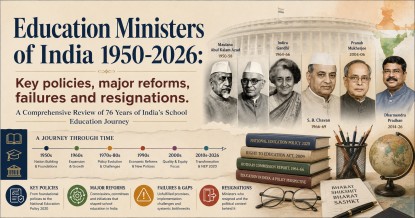
India’s education system has never been a neutral technocratic domain. From the first days of independence, it has remained a central arena of political contest over ideology, caste, region, minority representation and the very idea of the Indian nation. The Union Minister of Education (earlier Minister of Human Resource Development) has stood at the intersection of these contests. The portfolio has been used to build institutions, expand access, rewrite curricula, enforce social justice claims and, at times, to settle
ideological scores. The long list of ministers who held the charge between 1950 and 2026 reveals both remarkable continuity in structural problems and sharp breaks in political direction.
The Institutional Journey of the Ministry
At Independence the Ministry of Education was created under Maulana Abul Kalam Azad. In 1985 the Rajiv Gandhi government renamed it the Ministry of Human Resource Development, reflecting the developmental language of the era. In July 2020 the Narendra Modi government restored the original name, Ministry of Education, as part of the National Education Policy (NEP) 2020. The change of nomenclature was more than symbolic; it signalled a return to a narrower focus on education after decades in which the ministry had also handled culture, sports and youth affairs.
Throughout this period the minister has been responsible for school education, higher education, technical education, teacher training, curriculum frameworks and, increasingly, the high-stakes national entrance examinations. Because education is a concurrent subject, the Union minister’s real power has always depended on the ability to persuade, fund and, when necessary, coerce the states. That power has fluctuated with the strength of the central government and the political weight of the individual minister.
Ministers Who Resigned from the Portfolio
Resignations from the Union Education Ministry have been rare. Most ministers left office due to cabinet reshuffles, change of government, or, in one early case, death in office. Only two Union Education Ministers in the period under review formally resigned from the post:
Ramesh Pokhriyal ‘Nishank’ (2019–2021) resigned on 7 July 2021, citing health reasons, ahead of a major cabinet reshuffle in the Modi government.
Dharmendra Pradhan (2021–2026) resigned on 25 July 2026 after sustained student protests over repeated NEET paper leaks, particularly the major leak in 2026 that affected nearly 23 lakh candidates. His resignation followed weeks of demonstrations at Jantar Mantar and pressure from opposition parties and student groups.
These two cases stand out because they were formal resignations rather than routine exits. Pokhriyal’s departure was presented as health-related, while Pradhan’s exit was directly linked to a crisis of exam integrity and public accountability.
The Foundational Years: Azad and the Congress Consensus (1947–1966)
Maulana Abul Kalam Azad remains the most consequential figure in the early history of the ministry. A scholar, journalist and senior Congress leader with deep roots in the nationalist movement, Azad treated education as the primary instrument of nation-building. He established the University Grants Commission in 1956, supported the creation of the first Indian Institutes of Technology, and encouraged the founding of cultural institutions such as the Sahitya Akademi, Sangeet Natak Akademi and the Indian Council for Cultural Relations. His vision was deliberately secular and modernising. He believed that a common national education system would help overcome the communal divisions of Partition.
Critics later argued that this secular framework marginalised traditional Indian knowledge systems and created an over-centralised structure that subsequent governments found difficult to reform. Yet the institutions Azad built still form the backbone of Indian higher education. His long tenure (1947–1958) gave the ministry an early prestige that few later ministers matched.
K. L. Shrimali, Humayun Kabir and M. C. Chagla continued the Congress project of expansion. Shrimali emphasised teacher training and rural education. Chagla pushed science and technical education. These were years of institution-building rather than radical reform. The Kothari Commission (1964–66) produced the first comprehensive blueprint, but its recommendations were only partially translated into the National Policy on Education of 1968 under Triguna Sen. The pattern that would recur for decades was already visible: ambitious reports, slow and uneven implementation, and limited attention to learning outcomes.
The 1970s and the First Signs of Ideological Contest
Saiyid Nurul Hasan, a historian from Uttar Pradesh who held independent charge from 1972 to 1977, strengthened research bodies such as the Indian Council of Historical Research. His tenure is remembered by critics as the moment when left-leaning perspectives gained institutional dominance in the writing of history textbooks. The charge of “leftist capture” of educational institutions would later become a central theme of the BJP’s education politics.
The brief Janata interlude (1977–79) under Pratap Chandra Chunder produced little lasting change. The return of Congress under Indira and then Rajiv Gandhi restored continuity but not transformative energy.
The NPE 1986 Moment: P. V. Narasimha Rao
The most significant policy document of the post-Emergency decades was the National Policy on Education of 1986, drafted under P. V. Narasimha Rao. Rao, who later became Prime Minister, introduced Operation Blackboard, the Jawahar Navodaya Vidyalayas and the District Institutes of Education and Training. The policy spoke the language of universal elementary education, women’s education and vocationalisation. In practice, funding remained inadequate and implementation was left largely to the states. The gap between policy rhetoric and classroom reality became a permanent feature of Indian education governance.
The Politics of Reservation and Social Justice: Arjun Singh
Arjun Singh’s two tenures (1991–94 and 2004–09) illustrate how the education ministry became an instrument of caste politics. In his second term he pushed the expansion of 27 per cent OBC reservation in central higher education institutions, the IITs, IIMs, AIIMS and central universities, under the Central Educational Institutions (Reservation in Admission) Act, 2006. The decision followed the 93rd Constitutional Amendment and was justified as an extension of the Mandal Commission logic.
The policy triggered one of the most intense student agitations of the decade. Medical students across the country went on strike. The government eventually increased seats by 54 per cent to accommodate the new quota, but the episode revealed a recurring pattern: social justice claims were advanced without simultaneous investment in institutional capacity. For upper-caste students and many academic leaders the move symbolised the dilution of merit. For OBC and Dalit organisations it represented long-overdue justice. The education ministry under Arjun Singh became a battleground of caste arithmetic rather than a site of pedagogical reform.
The Saffronisation Debate: Murli Manohar Joshi
If Arjun Singh represented the politics of reservation, Murli Manohar Joshi (1998–2004) represented the politics of cultural nationalism. A physics professor from Allahabad and a senior RSS ideologue, Joshi used the ministry to revise NCERT textbooks. Critics accused him of “saffronisation,” inserting contested claims about ancient Indian scientific achievements, giving religious colouring to medieval conflicts, and promoting Vedic science and astrology courses. Supporters argued that he was merely correcting colonial and leftist distortions of Indian history.
The controversy was not merely academic. It demonstrated that curriculum is never neutral. Control of the education ministry gives a government the power to shape the historical memory of the next generation. Joshi’s tenure remains the clearest example of ideological capture of the school curriculum in the post-liberalisation period.
The Assessment Experiment and Its Failure: Kapil Sibal
Kapil Sibal (2009–2012) inherited the Right to Education Act and sought to modernise assessment. He introduced Continuous and Comprehensive Evaluation (CCE) and the no-detention policy up to Class 8. The intention was to reduce examination stress and encourage holistic development. In practice the system collapsed under weak teacher training, large class sizes and the absence of reliable learning metrics. Annual Status of Education Report (ASER) data continued to show that large percentages of Class 5 children could not read Class 2 texts or perform basic arithmetic. The no-detention policy was later diluted. Sibal’s tenure is remembered as a classic case of well-intentioned reform that ignored ground-level capacity.
The Digital Push and the Qualification Controversy: Smriti Irani and Prakash Javadekar
Smriti Irani’s short tenure (2014–2016) was dominated by controversy over her own educational qualifications and her handling of student protests at the Film and Television Institute of India and Jawaharlal Nehru University. The digital initiatives she launched were expanded under Prakash Javadekar, who strengthened the DIKSHA platform and the National Institutional Ranking Framework. Yet learning outcomes remained stubbornly low, and the coaching industry continued to thrive. Technology was treated as a substitute for the harder work of teacher accountability and curriculum coherence.
NEP 2020 and the Crisis of Exam Integrity: Ramesh Pokhriyal and Dharmendra Pradhan
Ramesh Pokhriyal ‘Nishank’ oversaw the finalisation of the National Education Policy 2020 and the restoration of the Ministry’s original name. NEP 2020 is the most ambitious policy document since 1986. It promises multidisciplinary education, mother-tongue instruction in the early years, vocational integration, and a complete overhaul of assessment. He resigned on 7 July 2021 citing health reasons.
Implementation then fell to Dharmendra Pradhan (2021–2026). Under him the government launched PM SHRI schools and the Anusandhan National Research Foundation. Digital platforms expanded. Yet the most visible legacy of his tenure is the repeated failure of the National Testing Agency to secure national entrance examinations. The NEET paper leak of 2026, which affected nearly 23 lakh students, produced sustained protests, a re-examination, a CBI investigation and, ultimately, Pradhan’s resignation on 25 July 2026. The crisis exposed a deeper institutional weakness: the ministry’s inability to guarantee the integrity of the high-stakes examinations that determine life chances for millions of young Indians, particularly those from socio-economically weaker sections who cannot afford multiple attempts or expensive coaching.
Recurring Structural Failures
Across seventy-five years certain problems have proved remarkably durable:
Learning outcomes have remained weak despite rising enrolment.
Curriculum has been a site of ideological contest rather than pedagogical consensus.
Social justice measures (reservations) have frequently outpaced institutional capacity.
Assessment reform has repeatedly prioritised process over measurable results.
Exam integrity has collapsed under the weight of a hyper-competitive system.
Over-centralisation has limited the ability of states to innovate, even though education is a concurrent subject.
Uttar Pradesh has been disproportionately represented among education ministers: Nurul Hasan, Sheila Kaul, V. P. Singh, Raj Mangal Pande, Murli Manohar Joshi and Atal Bihari Vajpayee (in additional charge). The state’s own education indicators, however, have often lagged national averages. The gap between the political importance of the portfolio and the quality of outcomes in India’s most populous state remains one of the sharper ironies of the story.
Politics, Pedagogy and the Road Ahead
The history of the Union Education Ministry is a history of political ambition colliding with administrative and pedagogical limits. Ministers have used the office to expand access, enforce social justice, rewrite national memory and launch grand policy frameworks. They have less often succeeded in the quieter, harder tasks of improving classroom teaching, ensuring exam integrity and building state capacity.
As India moves deeper into the implementation of NEP 2020, the vacancy created by Dharmendra Pradhan’s resignation is more than a personnel gap. It is a reminder that the credibility of the entire education system now rests on the ability of the ministry to restore public trust in the examinations that structure opportunity. Without that trust, even the most ambitious policy will remain a document rather than a transformation.
The ministers who held the portfolio between 1950 and 2026 left behind institutions, laws, textbooks and controversies. What they did not leave behind is a settled consensus on what Indian education is for. That question remains open and intensely political.
Education Ministers of India (1950–2026)