
India-US Trade Deal 2026: Pressure, Compromise or Smart Bargaining?
WEB'S ON FIRE
Chaifry
2/8/20268 min read
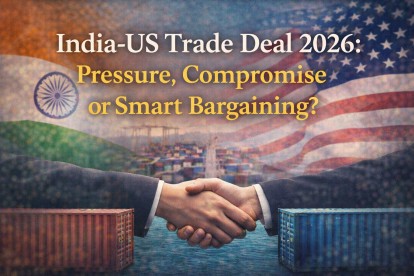
The February 2026 announcement of a revised US–India trade framework revealed a striking narrative dissonance between Washington and New Delhi. This article examines the agreement through the tripartite lens of external coercion, tactical compromise, and strategic bargaining. It argues that while intense US pressure in 2025 forced India into accelerated concessions, New Delhi’s minimalist public confirmation of terms, against expansive American claims, demonstrates calculated bargaining that preserved core sovereign interests despite an asymmetrical negotiating environment. The analysis highlights implications for Indian youth, economic autonomy, energy security, and long-term foreign-policy posture in an era of weaponized trade linkages.
1. Introduction: The Framing Dissonance
On February 2, 2026, the public rollout of a US–India trade understanding presented two parallel realities. One narrative, broadcast from Washington, described a “historic deal” involving sweeping Indian concessions on energy sourcing, massive procurement commitments, and tariff elimination. The other, issued from New Delhi, was a single-sentence official statement confirming only one concrete outcome: a reduction of the effective tariff rate on Indian goods entering the United States from 50% to 18%.
This analytical article interrogates that dissonance to answer a central question: does the 2026 agreement primarily reflect capitulation to intense external pressure, a mutual compromise between unequal partners, or a demonstration of smart bargaining by a rising power navigating great-power coercion?
The stakes are high. For the generation of Indian youth who will inherit the long-term economic, energy, and geopolitical consequences of this framework, the agreement is far more than a diplomatic footnote. It will influence inflation, job creation, startup funding flows, energy security, and India’s perceived autonomy on the global stage for decades.
2. The Coercive Campaign of 2025: Setting the Stage
The negotiation cannot be understood without first examining the twelve months of overt economic and rhetorical pressure that preceded it. By August 2025, the United States had imposed a 50% tariff structure on Indian goods: a 25% reciprocal tariff combined with an additional 25% punitive surcharge explicitly conditioned on India’s continued purchase of Russian crude oil. This linkage of trade penalties to a sovereign third-country energy choice marked a significant departure from established diplomatic norms. For decades, India and the United States had carefully insulated energy procurement decisions from bilateral trade negotiations.
The punitive campaign was amplified by repeated public statements from the US executive. President Trump labelled India a “dead economy” on multiple occasions via Truth Social. Senior administration officials employed unusually abrasive language in public remarks directed at New Delhi. The bilateral relationship appeared to reach its lowest point in several decades.
The October 2025 Pahalgam terror attack and the brief but intense India–Pakistan military exchange that followed added further strain. President Trump subsequently claimed credit for brokering a ceasefire; the Government of India maintained that the de-escalation was entirely bilateral. The divergent narratives exacerbated already tense optics.
It was against this backdrop of sustained economic coercion, public humiliation, and geopolitical friction that the February 2, 2026 announcement arrived. The headline reduction of tariffs from 50% to 18% appeared, at first glance, to represent a dramatic de-escalation. Closer examination, however, reveals a far more nuanced outcome.
3. The Substance of the Agreement: Confirmed Terms vs. Unconfirmed Claims
A careful parsing of official statements from both capitals is essential to separate fact from assertion.
Confirmed by both sides
Removal of the additional 25% punitive surcharge previously linked to Russian oil purchases.
Reduction of the base reciprocal tariff rate on Indian goods entering the United States to 18% (broadly comparable with Vietnam ≈20%, Thailand ≈19%, Bangladesh ≈20%).
Claimed by President Trump on Truth Social but not acknowledged in any official Indian communication
India will “halt” or substantially reduce purchases of Russian oil.
India will commit to procuring $500 billion worth of American goods and services over the next five years.
India will eliminate tariffs on US products entering the Indian market.
The contrast is stark. When the Prime Minister’s verified social-media post confirms only the 18% tariff adjustment, experienced diplomatic observers interpret the silence on the remaining three points as deliberate and meaningful. In high-stakes bilateral negotiations, omission is rarely accidental.
Commerce Secretary B.V.R. Subrahmanyam subsequently clarified that the categories of goods India intends to continue sourcing from the United States, crude oil and LNG, aircraft, information, and communications technology equipment, defence systems, data-centre hardware, were already part of India’s regular annual import basket. In other words, no dramatic new demand is being created; the adjustment largely involves re-direction of pre-existing procurement flows. Even when spread over five years, the $500 billion headline figure does not withstand elementary arithmetic scrutiny.
On Russian oil volumes: Rystad Energy data for January 2026 showed Russia still supplying 1.06 million barrels per day, the single largest share of India’s crude imports. The Kremlin publicly stated that “no official statement from India about halting purchases has been received.” India’s trade minister employed standard diplomatic language: energy procurement decisions will continue to follow “market dynamics and national interest.”
4. Assessing the Nature of the Bargain: Coercion, Compromise, or Smart Bargaining?
The truthful characterisation of the February 2026 outcome lies at the intersection of three dynamics.
4.1 Evidence of Significant Coercion
The 50% tariff structure was never conventional trade policy; it was a political instrument designed to impose maximum short-term pain. Reducing it to 18% is a partial reversal of overreach rather than an act of unilateral generosity.
The explicit linkage of tariffs to a sovereign third-country energy sourcing decision violated a long-standing diplomatic norm. For decades India and the United States had maintained a clear separation between energy procurement choices and bilateral trade relations. That boundary was breached.
The sustained public rhetorical campaign on Truth Social and in official statements created a high-visibility spectacle that made discreet, face-saving negotiation extremely difficult. India was compelled to respond to the public noise before it could address substantive issues.
4.2 Evidence of Tactical Compromise
India accepted a base tariff rate (18%) that, while an improvement on 50%, still leaves it at a competitive disadvantage relative to GSP beneficiaries and certain ASEAN economies.
There are credible indications of tacit flexibility on energy procurement diversification and incremental market-access concessions in sectors sensitive to US commercial interests.
The speed of the de-escalation suggests New Delhi concluded that further escalation would impose disproportionate short-term economic damage.
4.3 Evidence of Smart Bargaining and Counter-Leverage
NSA Ajit Doval’s late-January 2026 visit to Washington included a reported direct message to Secretary of State Rubio: India would not be bullied and was prepared to endure protracted tensions if necessary. This communicated credible resolve rather than capitulation.
India concluded a comprehensive, legally binding Free Trade Agreement with the European Union on January 27, 2026, only six days before the US announcement. That agreement with an $18 trillion economic bloc provided New Delhi with a credible alternative Western economic anchor. Multiple independent analyses (Bernstein Research, Carnegie Endowment for International Peace) concluded that the EU deal likely accelerated US negotiations; Washington did not wish to be outmanoeuvred in India’s rapidly expanding FTA network.
India simultaneously finalised trade agreements with the United Kingdom, Oman, and the EFTA bloc while initiating serious discussions with MERCOSUR and the Eurasian Economic Union. A country actively constructing alternative economic partnerships across every continent is not a country negotiating from a position of helplessness.
The synthesis is therefore clear: India faced intense, public, and economically painful coercion that forced tactical concessions sooner than New Delhi would have preferred. Yet through strategic diversification, clear red-line communication, and deliberate narrative control, India succeeded in limiting the scope and depth of those concessions. No legally binding commitment exists to cease Russian oil purchases. No enforceable $500 billion procurement target was accepted. No blanket zero-tariff undertaking was given.
5. Implications for Indian Youth: The Real, Everyday Stakes
This agreement is not an abstract diplomatic exercise. It directly affects the lives of millions of young Indians in four tangible dimensions.
5.1 Energy Prices and Household Inflation
Russia’s discounted Ural crude grade saves Indian refiners $8–12 per barrel relative to benchmark Middle Eastern alternatives. Replacing even 30% of current volumes with US-origin or other non-discounted crude will increase the landed cost of petrol, diesel, aviation turbine fuel, and indirectly cooking gas. For a young professional beginning their career in a metropolitan centre, that translates into higher monthly transport and food bills, reducing disposable income at precisely the moment when savings and investment capacity should be building.
5.2 IT Services and Manufacturing Employment
The 18% tariff rate is materially better than 50%, yet India remains at a competitive disadvantage relative to GSP-eligible economies (Vietnam, Bangladesh, Indonesia). IT services exports and electronics manufacturing may experience slower order growth if US purchasers redirect sourcing to lower-tariff origins. This dynamic translates into fewer campus placements, slower salary progression, and increased pressure on entry-level engineers, software developers, and manufacturing workers.
5.3 Startup and Venture-Capital Ecosystem
A large proportion of Indian unicorns and scale-ups continue to depend heavily on US venture-capital funding. Prolonged bilateral volatility or perceptions of over-dependence on US goodwill can make American investors more cautious. The widely reported (though unconfirmed) “$500 billion” headline creates perception risk that may affect future funding rounds.
5.4 National Pride and Geopolitical Self-Confidence
Young Indians increasingly seek to feel proud of India’s standing on the global stage. The aggressive public rhetoric emanating from Washington throughout 2025 injured national sentiment. The fact that India did not publicly accept every demand helps restore a measure of dignity. Yet the underlying precedent, that trade can be weaponised to influence sovereign foreign-policy choices, leaves a lingering unease about future vulnerability.
6. The Path Forward: Converting Pressure into Long-Term Advantage
Rather than viewing February 2026 as either capitulation or triumph, treat it as a loud strategic wake-up call.
6.1 Immediate Priorities (2026–2027)
Accelerate crude-oil source diversification: conclude additional long-term contracts with the United States, Saudi Arabia, Iraq, Guyana, Brazil, and other producers.
Intensify domestic upstream exploration (ONGC, Oil India Ltd) and renewable-energy deployment (solar, wind, green hydrogen) to reduce overall import dependence.
Leverage the tariff-relief breathing room to conclude aggressive FTAs with ASEAN, African Union members, Latin American blocs, and others, systematically reducing reliance on any single market.
6.2 Medium-Term Structural Reforms (2027–2030)
Make “Make in India” genuinely competitive in high-value segments (semiconductors, green hydrogen, defence electronics, electric vehicles) so that India becomes indispensable to US and global supply chains.
Reform factor markets (land acquisition, labour laws, capital access) to materially improve manufacturing competitiveness.
Introduce aggressive R&D tax credits, patent-box regimes, and university–industry collaboration incentives so that Indian firms can transition from services to innovation-driven exports.
6.3 Long-Term Mindset Shift (2030 onward)
Cease treating the US relationship as the single most important axis of Indian foreign policy. Cultivate deeper economic and strategic partnerships with Europe, Japan, Korea, Australia, the Gulf Cooperation Council, Africa, and ASEAN.
Develop and empower a new cadre of diplomats and trade negotiators skilled at quiet, interest-based bargaining rather than reactive public diplomacy.
Instil in young Indians the confidence that India’s scale, market size, demographic dividend, and strategic geography confer real and growing leverage, we do not need to be anyone’s junior partner.
7. Final Thought for India’s Young Generation
You will inherit the consequences of these agreements, higher fuel prices or better-paying jobs, constrained choices, or genuine strategic autonomy.
February 2026 was not a moment of surrender, but it was undeniably a moment of intense pressure. India conceded enough to de-escalate without surrendering core sovereign red lines. That tactical flexibility is valuable, but only if it is followed by accelerated domestic reform and ruthless diversification of external partnerships.
The true test is not what was (or was not) signed in February 2026. The true test is what India collectively achieves between now and 2030 to ensure that no future US president can ever again weaponise tariffs to dictate our energy choices or foreign-policy decisions. That work begins today, in classrooms, startup incubators, policy rooms, factories, and in the way each of you thinks about India’s place in the world. We have passed through far more difficult periods in our history. We will navigate this one as well. But only if we stop celebrating headlines and start executing the hard, unglamorous follow-through.
References
Bernstein Research. (2026). India–EU FTA: Implications for US negotiations. Bernstein Global Research.Carnegie Endowment for International Peace. (2026). The EU–India FTA and its impact on US–India trade talks. Carnegie India.
Institute of International Education. (2024). Open Doors 2023–24: Report on international educational exchange. IIE.
Rystad Energy. (2026). India crude import sources: January 2026 update. Rystad Energy Cube.
U.S. Citizenship and Immigration Services. (2025). H-1B petition fee guidance following September 2025 proclamation. USCIS.
U.S. Department of Homeland Security. (2025). Final rule: Admission periods for F-1 and J-1 nonimmigrants. DHS.
White House. (2025). Proclamation on supplemental fees for certain H-1B petitions. Office of the Press Secretary.