
What If Iran Breaks, Ukraine Buckles, and Washington Doubles Down in Venezuela?
GLOBAL AFFAIRS, POLITICAL ECONOMY, GOVERNANCE & INSTITUTIONSPOLITICS
Chaifry
1/10/20266 min read
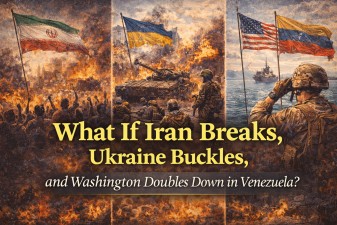
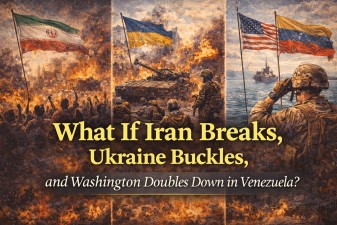
A 2026 NATO stress-test scenario — and why the next wave of civil unrest could go global.
Imagine the next few weeks deliver a three-front shock: Iran’s protest cycle tips into real state fracture; Ukraine is pushed toward a settlement that looks like a loss; and Washington escalates in Venezuela to project dominance across the Caribbean Sea. What happens next is not only a foreign policy question. It becomes a domestic stability test across NATO countries — shaped by cost-of-living anxiety, migration politics, and polarization.
This article lays out a structured “what if” path: triggers, likely NATO reactions, what the major parties want, and how civil unrest, protests, riots, and demonstrations could spread through the information space as much as the streets.
Reader note: This is a 'what if' scenario built from current signals and public reporting. It is not a forecast and it is not a claim about intent. The goal is to pressure-test NATO and partner responses under stacked crises.
Quick read (60 seconds)
This scenario becomes plausible when three pressures stack: NATO-edge escalation in Ukraine, regime stress in Iran, and a U.S. Venezuela posture that invites legal and political blowback.
NATO unity would likely hold in language, but fracture in appetite: frontline states push deterrence; others prioritise domestic stability and migration politics.
The biggest accelerant is not a single strike — it is the public’s loss of confidence in institutions, amplified by polarization and media loops.
Search spikes would cluster around concrete nouns: Oreshnik missile, NATO deployment, Iran internet blackout, Venezuela war powers vote, Taiwan blockade drills, Red Sea shipping disruption.
1) Why this “what if” is on the table right now
The scenario is built on signals already visible in public reporting. On the NATO edge, Russia’s use of a hypersonic Oreshnik missile near western Ukraine, close to Poland, has been framed as intimidation aimed at Western support. Meanwhile, the UK has earmarked funding to prepare for a possible troop deployment to Ukraine in a post-ceasefire setting. And in the Americas, the U.S. Senate has advanced a War Powers measure designed to curb further unilateral military action against Venezuela — a rare institutional brake that usually appears only when lawmakers fear long, expensive entanglement.
Ukraine/NATO edge: Russia launches a hypersonic Oreshnik missile near Lviv, close to the Poland border; European allies call it an escalation. (Reuters, 9 Jan 2026)
Post-ceasefire planning: UK allocates £200m to prepare for potential deployment as part of a multinational force. (Reuters, 9 Jan 2026; Barron’s, 9 Jan 2026)
Venezuela constraint: U.S. Senate advances a war powers resolution to restrict further hostilities without Congress. (Reuters, 8 Jan 2026; TIME, 8 Jan 2026)
Iran stress: protests expand amid economic hardship and internet disruptions; the Supreme Leader prepares a speech describing events as ‘terrorist actions’. (Reuters, 9 Jan 2026; PBS, 4 Jan 2026; Human Rights Watch, 6 Jan 2026)
Taiwan pressure: China’s drills around Taiwan simulate blockade conditions around key ports. (The Guardian, 29 Dec 2025; Al Jazeera, 30 Dec 2025)
Red Sea cost channel: Red Sea shipping disruptions raise costs, delay flows, and can add inflation pressure if prolonged. (U.S. CRS, May 2024)
2) The trigger triad: three events that turn noise into a system shock
Trigger A: Iran shifts from protests to fracture
In this scenario, Iran does not ‘collapse’ in a single day. It fractures. A widening protest movement meets harsher repression, internet blackouts become routine, and parts of the security apparatus split in loyalty. Economic stress turns into a legitimacy crisis. The moment this becomes global is when energy risk and regional spillover dominate headlines — and when disinformation becomes indistinguishable from eyewitness content.
Trigger B: Ukraine is forced into a settlement that reads like defeat
Ukraine’s ‘loss’ here is political as much as territorial: a ceasefire or settlement that rewards coercion and signals that deterrence has limits. Strikes near NATO borders amplify fear that the conflict could widen — and they harden the argument inside Europe that ‘peace’ without enforceable security guarantees is just a pause.
Trigger C: Washington escalates in Venezuela to prove Caribbean Sea dominance
If Washington feels credibility slipping on one front (Ukraine) while disorder rises on another (Iran), a nearby theatre can look attractive: shorter supply lines, clearer messaging, and a story that fits domestic politics. But this is where the scenario becomes dangerous. ‘Supremacy’ in the Caribbean Sea can be signaled offshore. ‘Control’ onshore is a different project: legitimacy, services, and long-term security.
3) NATO responses: unity in language, divergence in appetite
If the three triggers stack, NATO countries are likely to converge on statements of unity while diverging on what they will actually do. Three blocs usually appear in multi-crisis periods:
Bloc 1: Frontline reassurance (Baltics, Poland-adjacent politics, parts of Nordics)
Priority: visible deterrence, air defense, intelligence, logistics hardening.
Instinct: treat any Ukraine-edge escalation as a direct NATO credibility challenge.
Bloc 2: Ceasefire-guarantee planners (UK-France lead, willing coalition)
Priority: post-ceasefire enforcement concepts, rapid deployment readiness, joint command arrangements.
Risk: becomes politically explosive if domestic publics see it as open-ended commitments.
Bloc 3: Domestic-stability first (inflation, migration politics, cyber threats)
Priority: reduce spillover at home: cost pressures, energy exposure, migration volatility, and social cohesion.
Risk: “Ukraine fatigue” narratives and polarization pressure coalition coherence.
4) ‘All parties’ calculus: what each actor wants in this scenario
A useful way to read crises is to ignore slogans and watch incentives. Here’s what the main players would likely seek:
Russia
Goal: weaken European will, raise the perceived cost of support, and frame NATO planning as escalation.
Toolset: intimidation messaging, infrastructure strikes, and information operations aimed at alliance publics.
Ukraine
Goal: prevent a settlement that normalises coercion; secure credible guarantees if talks advance.
Toolset: diplomatic coalition-building, battlefield resilience, and narrative focus on NATO-edge risk.
Iran’s leadership vs Iran’s streets
Leadership goal: survive the protest cycle and prevent security fragmentation; blame external ‘saboteurs’.
Protesters’ goal: regime change or deep reform; economic relief; end to repression and blackouts.
United States (Trump administration)
Goal: project decisiveness and shape outcomes in a near theatre; manage domestic political narratives.
Constraint: War Powers politics — Congress pushes back if hostilities look open-ended.
European NATO members
Goal: avoid a credibility collapse in Europe while containing domestic blowback (prices, migration, cyber).
Constraint: elections, coalition politics, and the speed of public opinion during polarization cycles.
China and Taiwan
China goal: probe alliance cohesion and normalize blockade-capability signaling.
Taiwan goal: keep deterrence credible; prevent ‘blockade-as-normal’ becoming accepted.
5) The civil unrest feedback loop: how foreign shocks become domestic protests
The underappreciated risk is not only escalation abroad. It’s the way stacked crises turn into domestic political unrest. When publics lose confidence that leaders can control outcomes, the same pattern repeats: protests, counter-protests, and street-level clashes that look like riots on camera even when the original demonstrations were peaceful.
Where protests and riots would most likely flare
Venezuela: street demonstrations and counter-demonstrations around a contested transition, with security force splits.
Europe: protest waves linked to cost-of-living, ‘endless war’ fatigue, and migration fear narratives.
U.S. and allies: polarization drives rapid mobilisation on both sides; media ecosystems amplify ‘winner/traitor’ framing.
Youth mobilisation: Gen Z protests surge where corruption and stagnation meet crackdowns and viral imagery.
Why ‘immigration riots’ becomes a search term (even when reality is more complex)
In election-season politics, migration often becomes shorthand for broader social anxiety. If Iran and Venezuela are both framed as spillover drivers, some politicians and outlets will push the most alarmist language. That language then becomes what people search — regardless of whether it describes the underlying reality.
6) What to watch over the next 14 days
If this scenario starts materialising, the earliest signals are usually procedural and logistical, not dramatic. Watch for:
More NATO-edge strikes or weapons signaling near alliance borders.
Concrete movement on the UK/France ‘multinational force’ planning: basing, rules of engagement, command structure.
Iran communications: sustained blackouts, mass arrest numbers, security defection rumors, and Khamenei’s framing.
U.S. congressional moves on War Powers and any new authorizations or restrictions.
China drill tempo and geography, especially around simulated blockade choke points.
Shipping cost indicators tied to Red Sea disruption, including insurance premiums and rerouting announcements.
Conclusion: the real stress test is bandwidth
The cinematic version of this scenario is ‘America takes full control of Venezuela’. The realistic version is harder: a multi-crisis period where NATO has to keep deterrence credible in Europe while managing domestic stability shocks, misinformation pressure, and polarization. If Iran fractures and Ukraine buckles at the same time, every move becomes a referendum at home — and that is where alliances quietly get weaker.
References
Reuters (9 Jan 2026). Russia fires hypersonic missile at target in Ukraine near NATO border.
Reuters (9 Jan 2026). UK allocates £200 million to prepare for possible Ukraine deployment.
Barron’s/AFP (9 Jan 2026). UK earmarks £200m to prepare for Ukraine deployment.
Reuters (8 Jan 2026). US Senate advances measure curbing Trump’s Venezuela war powers.
TIME (8 Jan 2026). Senate backs War Powers measure intended to block Trump in Venezuela.
Reuters (9 Jan 2026). Iran’s Supreme Leader to give speech about protests; NetBlocks reports internet blackout.
PBS NewsHour / AP (4 Jan 2026). What to know about protests over Iran’s economy as nuclear tensions remain high.
Human Rights Watch (6 Jan 2026). Iranian authorities brutally repressing protests.
The Guardian (9 Jan 2026). Russia launched hypersonic Oreshnik missile near EU border; allies alarmed.
The Guardian (29 Dec 2025). China launches live-fire drills around Taiwan simulating blockade of key ports.
Al Jazeera (30 Dec 2025). How are China’s new war games around Taiwan different from earlier drills?
Congressional Research Service (8 May 2024). Red Sea Shipping Disruptions: Estimating Economic Effects (IF12657).
Verisk Maplecroft (Dec 2025). Escalating unrest, polarisation, economic woes set stage for disruptive 2026.
Timoneda & Wibbels (2021). Spikes and Variance: Using Google Trends to Detect and Forecast Protests. Political Analysis.