
Jürgen Habermas: A Portrait of a Public Intellectual
BOOKS REVIEW
Chaifry
3/15/20267 min read
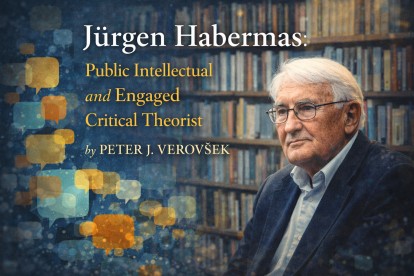
Peter J. Verovšek, a political theorist and lecturer at the University of Sheffield, has established himself as one of the most thoughtful contemporary interpreters of Jürgen Habermas’s vast and evolving body of work. Verovšek’s earlier writings have already traced the German philosopher’s shift from early Frankfurt School roots toward a more explicitly democratic and cosmopolitan orientation. Jürgen Habermas: Public Intellectual and Engaged Critical Theorist (Verovšek, 2026), published by Columbia University Press in the New Directions in Critical Theory series (volume 91) in a hardcover edition released in early 2026,
offers the first comprehensive intellectual biography to appear after Habermas’s death in 2024. The book traces Habermas’s seven-decade career from his doctoral dissertation on Schelling through the structural transformation of the public sphere, the theory of communicative action, discourse ethics, the post-national constellation, and his late interventions on European integration, migration, digital surveillance, and the climate crisis.
The book’s central thesis is both scholarly and civic: “Habermas never retreated into academic quietism; he consistently understood critical theory as an engaged practice that must speak to and be tested by the concrete problems of its historical moment” (Verovšek, 2026, p. 14). Verovšek argues that Habermas’s enduring relevance lies in his refusal to separate rigorous philosophical reflection from public responsibility. In an era when academic specialization often produces increasingly narrow and inward-looking scholarship, this serves as a gentle yet urgent wake-up call to the ground reality that intellectual work gains its deepest meaning when it attempts to clarify and improve the conditions of shared democratic life. Everyone should read it because the portrait Verovšek draws is not merely historical; it is a model of what a committed public intellectual can look like in the twenty-first century.
Verovšek organizes the book chronologically while thematically grouping Habermas’s major contributions under three overarching phases: the early critique of distorted communication, the mature elaboration of discourse ethics and deliberative democracy, and the late defence of constitutional patriotism and post-national solidarity. The core argument is that Habermas’s thought forms a coherent project of rationalisations through communication, a lifelong effort to show that reason is not an abstract faculty, but a social practice embedded in everyday language use. Evidence is drawn from close readings of Habermas’s major texts, archival material, correspondence, interviews and the secondary literature in German, English, and French. Verovšek is especially attentive to Habermas’s responses to historical events, the student protests of 1968, German reunification, the Yugoslav wars, 9/11, the Eurozone crisis, the refugee movement of 2015, Brexit, the rise of right-wing populism and the COVID-19 pandemic.
The opening chapter situates Habermas within the first generation of the Frankfurt School: “Unlike Adorno and Horkheimer, who increasingly saw reason as complicit in domination, the young Habermas insisted that communicative reason contains an emancipatory potential that can be redeemed” (p. 28). “His 1962 habilitation thesis already argued that the bourgeois public sphere was not merely an ideological illusion but a normative ideal that could be radicalised” (p. 35). “Habermas sought to rescue the public sphere from its own historical decline” (p. 42).
The second section traces the development of the theory of communicative action: “Habermas distinguished between strategic action oriented toward success and communicative action oriented toward mutual understanding” (p. 67). “The validity claims raised in speech, truth, rightness, sincerity, provide immanent standards for criticising systematically distorted communication” (p. 74). “Discourse ethics emerged as the attempt to ground moral norms in the presuppositions of rational argumentation itself” (p. 89). “The ideal speech situation is not a utopian blueprint but a counterfactual standard embedded in language use” (p. 96).
Verovšek devotes a full chapter to Habermas’s conception of deliberative democracy: “Democracy is not primarily about aggregating preferences but about forming preferences through inclusive public reasoning” (p. 112). “The public sphere must be protected from colonisation by money and administrative power” (p. 119). “Legitimacy arises when citizens can understand themselves as authors of the laws they obey” (p. 126). “Deliberative democracy requires both strong procedural guarantees and a vibrant civil society” (p. 133).
The later chapters address Habermas’s turn to constitutional patriotism and post-national democracy: “In a pluralistic society, constitutional principles rather than ethnic or cultural identity must serve as the focal point of political loyalty” (p. 145). “The European Union represents the most ambitious attempt yet to institutionalise democracy beyond the nation-state” (p. 152). “Cosmopolitan solidarity is no longer an empty ideal; it has become a practical necessity in the face of climate change and global capital” (p. 167). “A democratic global order cannot be imposed from above; it must emerge through transnational public spheres” (p. 174).
Verovšek also examines Habermas’s public interventions: “He warned that the financialisation of the economy threatens the very preconditions of democratic self-determination” (p. 189). “During the refugee crisis he criticised the post-democratic tendency to treat migration as a managerial problem rather than a moral and political one” (p. 196). “His late essays on digital communication argue that social media undermine the reflective distance necessary for genuine public deliberation” (p. 212). “Climate change demands a new form of global cooperation that existing nation-state frameworks cannot deliver” (p. 219).
The book closes with a balanced assessment: “Habermas’s work is unfinished, as all living philosophy must be” (p. 234). “Yet the questions he posed about reason, democracy, and the possibility of a rational society remain as pressing as ever” (p. 241). “Critical theory today must remain engaged, fallible, and open to learning from the very public it seeks to enlighten” (p. 248). “Habermas’s legacy is not a finished system but an open invitation to continue the project of rational self-clarification” (p. 255).
Jürgen Habermas: Public Intellectual and Engaged Critical Theorist is a model of intellectual biography: clear, comprehensive, and philosophically serious without becoming inaccessible. Verovšek’s greatest strength is his ability to trace the internal logic of Habermas’s development while keeping the external historical context in sharp focus. The account of the shift from the early critique of ideology to the theory of communicative action is particularly lucid: “Habermas did not abandon critical theory; he reformulated it so that emancipation could be grounded in the structures of language itself” (p. 74). The treatment of discourse ethics is equally precise, showing how Habermas attempted to rescue moral universalism from both positivist relativism and postmodern scepticism.
The chapters on constitutional patriotism and the post-national constellation are among the strongest in the book. Verovšek convincingly shows that Habermas’s defence of the European project was never naive: “He always insisted that supranational institutions must be democratically accountable if they are to avoid becoming technocratic” (p. 152). The discussion of Habermas’s response to right-wing populism is timely and sobering: “Populism exploits the pathologies of the public sphere rather than transcending them” (p. 212).
Verovšek’s prose is admirably clear and free of unnecessary jargon. He quotes Habermas generously but always integrates the quotations into his own argument rather than letting them stand alone. The bibliography is extensive and up-to-date, including many lesser-known German-language articles and interviews.
Weaknesses are comparatively minor. The book is very much an intellectual biography rather than a full personal or political biography; readers hoping for more detail on Habermas’s private life, institutional battles within the Frankfurt School or his relationships with contemporaries (Adorno, Marcuse, Apel, Luhmann, Foucault, Rawls) will find relatively little. Intersectional analysis is largely absent; questions of gender, race and postcolonial critique are mentioned only in passing, even though Habermas himself engaged with some of these themes in his later writings on multiculturalism and global justice.
The treatment of Habermas’s late work on digitalisation and the climate crisis is somewhat compressed compared with the earlier phases. Verovšek notes the philosopher’s concern about the fragmentation of the public sphere but does not fully explore how Habermas’s own communicative model might need updating in the face of algorithmic governance and ecological collapse.
Despite these limitations, Verovšek has produced an indispensable guide to one of the twentieth century’s most important thinkers. The book does not merely summarise Habermas; it makes a compelling case for why his project remains unfinished, and therefore indispensable.
Why Indian Youth Readers Must Read This Book
Nestled amid India’s coaching coliseums and corporate coliseums, where rote regimens regurgitate rankings yet recoil from genuine reflection, Peter J. Verovšek’s Jürgen Habermas: Public Intellectual and Engaged Critical Theorist arrives like a gust of old monsoon breeze, brushing away the bustle with quiet insistence. For the alert twenty-somethings confronting tech tempests or tutoring tempests, those dusk deliberations on whether the “secure” path will ever ignite the soul, this intellectual biography is an elder’s understated epistle, epistle bypassing the syllabus to the public conscience beneath.
Our scholastic sanctuaries, sanctifying scores sans the spark to question, mirror the very pathologies Habermas diagnosed: the colonisation of the lifeworld by systemic imperatives. “The public sphere must be protected from colonisation by money and administrative power” (p. 119) lands like cool water on burnt skin for students conditioned to treat education as a ladder rather than a conversation. “Democracy is not primarily about aggregating preferences but about forming preferences through inclusive public reasoning” (p. 112) becomes a quiet reminder that real learning happens when we learn to listen, not merely to win.
The ground reality rasps rougher in the graduate gust: millions competing for meagre mandates, portfolios pounding like monsoon memos, “cultural fit” often a coded cull for caste cues or class codes. Verovšek’s portrait of Habermas as a thinker who refused academic quietism, “Critical theory must remain engaged, fallible, and open to learning from the very public it seeks to enlighten” (p. 248), offers medicine for young professionals navigating office politics, client calls or family WhatsApp groups where speaking truth to power feels risky. “Legitimacy arises when citizens can understand themselves as authors of the laws they obey” (p. 126) speaks directly to those playing catch-up with legacy networks or family expectations.
Societal skeins snag snugger: mavens mandating “matrimonial mandates” while musings meander to media or missions, the yank like Yamuna yarns on a weaver’s warp. “In a pluralistic society, constitutional principles rather than ethnic or cultural identity must serve as the focal point of political loyalty” (p. 145) challenges the quiet acceptance of exclusionary belonging. “Cosmopolitan solidarity is no longer an empty ideal; it has become a practical necessity” (p. 167) empowers daughters doubling duties to claim space in digital dawns and sons shouldering expectations to think beyond narrow loyalties.
Global gleanings from the book, from Frankfurt seminars to Varanasi reflections, widen warps from Varanasi veenas to virtual vines, spurring UpGrad unions or Unacademy unveilings linking Ladakhi learners to luminous legacies. For our young yarn-spinners, straddling sari strictures and soaring soliloquies, Jürgen Habermas: Public Intellectual and Engaged Critical Theorist reflects rudraksha rings: it exhumes entrenched “unquestioned obedience,” from debate derails to dowry dilemmas, craving the clarity to chant “The questions Habermas posed remain as pressing as ever” (p. 241). Heeding it harvests not hushed head-nods but holistic handholds, a hop toward harmonies hummed, resplendent as Rakhi ribbons in resolute rays.
Jürgen Habermas: Public Intellectual and Engaged Critical Theorist lingers as a ledger of luminous clarity, its pages a lantern in the labyrinth of democratic hope. Verovšek, with scholar’s exactitude and citizen’s warmth, avows that critical thought, practised responsibly, graces the graspable. Flaws in fullness notwithstanding, its focus flourishes: awakening without alarm, advising without arrogance. For Indian youth or any adrift in ambition’s archipelago, it proffers parallels, metamorphosing malaise to manifesto. In epochs of evaporate equanimity, imbibing its intimations is imperative; it is the quiet frame that frees the future’s flow.