
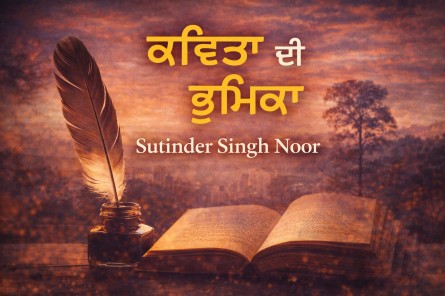
Kavita Di Bhumika by Sutinder Singh Noor
SAHITYA AKADEMI AWARD-PUNJABI
Chaifry
2/4/20265 min read
Sutinder Singh Noor (born 1943) belongs to the most influential generation of post-1947 Punjabi critics and literary theorists. After completing his doctorate on the Punjabi novel under the supervision of Prof. Harbhajan Singh, he taught Punjabi literature for over three decades at Delhi University and later served as Editor of the Punjabi Tribune and Professor Emeritus. His critical writing is characterised by a rare combination of close-reading rigor, sociological awareness, comparative perspective, and a consistently anti-dogmatic stance.
Kavita Di Bhumika (The Ground of Poetry / The Preface to Poetry), published in 2002 by Chetna Prakashan, Ludhiana, was awarded the Sahitya Akademi Award for Punjabi in 2004. The book is neither a conventional history of Punjabi poetry nor a systematic poetics textbook. It is best described as a long, sustained critical meditation that attempts to answer a single fundamental question: what makes a text recognisably poetry in the Punjabi linguistic and cultural field after 1947, and how has that recognition itself changed?
The central argument of this review is that Kavita Di Bhumika remains, more than twenty years after publication, the most ambitious and intellectually honest attempt in Punjabi to write a post-Partition poetics that is simultaneously historical, formal and existential and that its strength lies precisely in the fact that it refuses to offer a single, comforting answer.
The book is built around six long chapters (plus an extended introduction and a brief afterword), each of which can be read as an independent essay while together they form a single arc of argumentation.
1. The first chapter (“Kavita di Buniyad te Samajik Sandarbh”) lays the theoretical foundation. Noor argues that poetry is not an ornament added to language but the most concentrated form of language’s self-awareness. He draws on both Indian aesthetic traditions (rasa, dhvani, vakrokti) and selected Western theorists (Jakobson, Mukarovsky, Adorno) to claim that the poetic function arises when language draws attention to itself while simultaneously pointing beyond itself toward an unspoken social experience.
“Kavita sirf shabad nahi, shabad da samajik avchetan hai.” (Poetry is not merely words; it is language’s social unconscious.)
2. The second chapter examines the rupture of 1947 as a constitutive break in Punjabi poetic sensibility. Noor contends that the older lyrical tradition (Waris Shah–Amrita Pritam lineage) could not survive the scale of collective trauma and forced migration without undergoing a deep formal and emotional mutation.
“1947 ton baad Punjabi kavita di sab ton vaddi badli eh hai ki eh hor romantic reh nahi sakdi si.” (The biggest change in Punjabi poetry after 1947 is that it could no longer remain romantic.)
3. The third chapter (“Adhunikta ate Punjab di Kavita”) analyses the arrival of modernism in Punjabi poetry between roughly 1955–1975. Noor gives a sympathetic but critical reading of the first-generation modernists (especially Mohan Singh, Pritam Singh Safeer, Harbhajan Singh) and argues that their attempt to import Western modernist techniques often resulted in a split sensibility intellectually radical but emotionally nostalgic.
“Modernism Punjabi vich aaya, par jadon aaya taan oh apne naal apni hi kami le ke aaya.” (Modernism came to Punjabi, but when it came it brought its own incompleteness with it.)
4. The fourth chapter is the most original: “Bhasha di Sankat ate Kavita di Sambhavna.” Here Noor argues that the single greatest crisis facing Punjabi poetry after the 1980s is linguistic the accelerating shrinkage of the Punjabi reading public, the dominance of English and Hindi in education, and the fragmentation of the Punjabi speech community itself.
“Jis din Punjabi bhasha apne aap nu bachavan layi ladna chhad degi, us din kavita vi mar javegi.” (The day Punjabi language stops fighting to save itself, poetry will die on the same day.)
5. The fifth chapter offers close readings of selected post-1970 poets (Surjit Patar, Satiq, Amitoj, Darshan Singh Awara, among others) to illustrate how younger generations have tried to resolve or at least live with the crises diagnosed earlier.
“Naven kaviyan ne purani kavita di rooh nu nahi, balki purani rooh diyan haddan nu paar kar ditta.” (The new poets have not preserved the soul of old poetry; they have crossed the boundaries of that old soul.)
6. The final chapter (“Aakhri Vichar”) refuses closure. Noor ends by saying that the future of Punjabi poetry depends on whether the language community can invent new institutions of reading and listening that are adequate to the fractured reality it now inhabits.
“Kavita di bhumika likhan layi ajj vi kalam nahi ajj vi sirf ik saah hi kaafi hai.” (To write the preface to poetry today, a pen is still not enough even now a single breath is sufficient.)
Intellectual courage and honesty Noor never hides behind fashionable theoretical jargon. When he says that much of what passes for “progressive” Punjabi poetry after 1970 is emotionally shallow or ideologically repetitive, he says it plainly. When he admits that the modernist experiment in Punjabi failed to produce a lasting formal revolution, he says it plainly. This refusal to offer consolation is rare in award-winning criticism and gives the book genuine moral authority.
Lucid macro-historical framework the chapter on the linguistic crisis of Punjabi is among the clearest and most persuasive diagnoses ever written in any Indian language. Noor does not blame English alone; he points to the internal failures of the Punjabi elite refusal to create robust secular institutions of reading, over-dependence on state patronage, inability to build a genuine public sphere and he does so without descending into mere lamentation.
Close reading that respects the poem The readings of Surjit Patar, Satiq and Amitoj are exemplary. Noor never forces a poem to illustrate a pre-existing thesis; he lets the poem speak and then asks what formal choices made that speaking possible. The ten-page discussion of Patar’s “Hanere Vich Sulagdi Varnmala” is particularly fine it shows how a single image (the burning alphabet) can become the organising principle of an entire poetic world.
Avoidance of nostalgia Despite being a senior scholar, Noor refuses to romanticise the pre-1947 lyrical tradition. He acknowledges its emotional power but insists that it became historically unavailable after the catastrophe of Partition and the subsequent linguistic fragmentation. This refusal to take refuge in the past gives the book its contemporary urgency.
Underdeveloped engagement with women poets Although Noor mentions several women poets (Prabodh, Neelam, etc.), the book contains no sustained reading of any female voice. In a collection that claims to discuss the entire post-1947 field, the near absence of feminist or gendered critique is a serious gap.
Limited attention to experimental and Dalit poetry the book is strongest on the mainstream modernist canon (Mohan Singh → Harbhajan Singh → Surjit Patar). Poets working in more radical experimental modes (Lal Singh Dil, Sant Ram Udasi, Darshan Minhas) or in the emerging Dalit literary movement receive only passing mention. This creates an impression of a conservative canon.
Occasional over-generalisation Statements like “the Punjabi ghazal after 1970 became decorative” or “experimental poetry in Punjabi has not produced any major voice” are provocative but insufficiently substantiated. A more granular discussion of individual poets who attempted formal innovation would have strengthened the argument.
Relative neglect of the oral-performative dimension Given that Punjabi poetry remains an oral and performative art (kavi darbars, melas, ghazal recitals), the exclusively textual focus of the analysis feels one-sided. A chapter on how poetry is received and circulated in Punjab would have made the diagnosis of the linguistic crisis more concrete.
Kavita Di Bhumika is not a comfortable book. It refuses to celebrate Punjabi poetry uncritically; it refuses to offer easy solutions to the language’s crisis; it refuses to hide behind academic jargon or sentimental nostalgia. Precisely because of these refusals, it remains more than twenty years after publication one of the most serious and necessary critical works in Punjabi. Its central insight that the future of Punjabi poetry depends on whether the language community can invent new ways of reading, listening, and feeling together is as urgent in 2025 as it was in 2002.
Rating: 4.7 / 5
Recommendation: Strongly recommended especially for postgraduate students, teachers, and serious readers of Punjabi poetry. It should be compulsory reading in every M.A. Punjabi syllabus in India and Pakistan.