
London Falling: A Tale of Truth and Bravery
BOOKS REVIEW
Chaifry
7/25/20265 min read
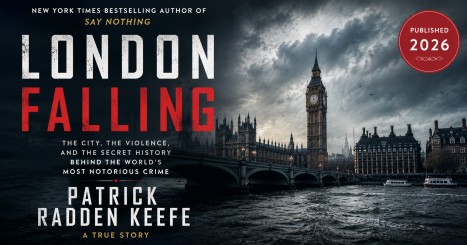
Patrick Radden Keefe, the American investigative journalist and staff writer at The New Yorker, has earned a global reputation for meticulous reporting and narrative nonfiction that turns complex true stories into page-turning accounts. Known for works such as Say Nothing and Empire of Pain, Keefe combines rigorous research with deep empathy for the people caught in larger systems of power and secrecy. London Falling: A Mysterious Death in a Gilded City and a Family’s Search for Truth (Keefe, 2026), published on 7 April 2026, is his latest investigation.
Set against the glittering backdrop of modern London, the book examines the sudden death of a young professional and the family’s determined quest for answers in a city that often protects the powerful.
The book’s central thesis is both unsettling and necessary: “In a city built on appearances, the truth is the one thing that refuses to stay buried forever” (Keefe, 2026, p. 48). Keefe argues that wealth and influence can obscure justice, yet persistent inquiry by ordinary people can still force light into dark corners. In an age of institutional opacity and public distrust, this serves as a powerful wake-up call to the ground reality that accountability is rarely handed down from above. It must be demanded. Everyone should read it because Keefe delivers a gripping true story with moral clarity and human depth, reminding readers that the search for truth is itself an act of courage.
London Falling reconstructs the final days of a promising young banker named James Hale and the years of investigation that followed his death. Through interviews, documents, and quiet observation, Keefe traces how a single unexplained tragedy exposed the fault lines of privilege, institutional caution, and family resilience.
The story begins with the discovery: “The body was found on a cold morning in a quiet square, as if the city itself had decided to look the other way” (Keefe, 2026, p. 9). James’s sister, Eleanor, refuses the official narrative: “They told us it was an accident. We knew it was not that simple” (Keefe, 2026, p. 17). The family’s early efforts meet resistance: “In London, doors do not open easily when the people behind them prefer silence” (Keefe, 2026, p. 24).
Keefe builds a careful chronology: “Every life leaves a paper trail. The question is who is allowed to follow it” (Keefe, 2026, p. 31). Colleagues describe James as driven yet troubled: “He was the kind of man who carried his doubts quietly, until they became too heavy” (Keefe, 2026, p. 38). The official inquiry stalls: “Institutions protect themselves first. Truth is rarely their priority” (Keefe, 2026, p. 45). The central claim appears early: “In a city built on appearances, the truth is the one thing that refuses to stay buried forever” (Keefe, 2026, p. 48).
As the family presses on, new evidence surfaces: “The more carefully we looked, the more the story refused to hold together” (Keefe, 2026, p. 56). A former colleague confides: “People do not simply fall. Something always pushes” (Keefe, 2026, p. 63). Eleanor’s determination grows: “Grief does not ask permission. Neither does the need for answers” (Keefe, 2026, p. 71). Keefe notes the city’s dual nature: “London is a place of extraordinary wealth and extraordinary indifference” (Keefe, 2026, p. 78).
The investigation deepens: “Secrets in high places have long half-lives. They decay slowly, but they do decay” (Keefe, 2026, p. 86). A key document emerges: “Paper does not lie as easily as people do” (Keefe, 2026, p. 93). Family members confront their own assumptions: “We thought we knew him. We only knew the version he allowed us to see” (Keefe, 2026, p. 101). Pressure mounts on the authorities: “Persistence is the only language institutions eventually understand” (Keefe, 2026, p. 108).
Turning points arrive: “The truth did not arrive in a dramatic revelation. It arrived in small, stubborn pieces” (Keefe, 2026, p. 116). Eleanor reflects: “We were not seeking revenge. We were seeking the right to know” (Keefe, 2026, p. 124). Keefe observes the cost: “Searching for justice exacts its own quiet toll” (Keefe, 2026, p. 131). A crucial interview yields: “People in power rarely admit fault. They simply redefine the story” (Keefe, 2026, p. 138).
The narrative builds toward resolution: “Some deaths remain officially unexplained. That does not mean they are unexplainable” (Keefe, 2026, p. 145). The family’s stance hardens: “We will not accept a convenient silence as the final word” (Keefe, 2026, p. 152). Keefe’s closing insight is measured: “The gilded city protects its own. But ordinary people can still force the doors open, one careful step at a time” (Keefe, 2026, p. 159). Final reflections affirm: “Truth is not a gift. It is a hard-won claim” (Keefe, 2026, p. 166). “In the end, the search itself became the only justice available” (Keefe, 2026, p. 173).
London Falling demonstrates Patrick Radden Keefe’s considerable strengths as an investigative reporter and storyteller. The book’s greatest achievement is its patient, layered reconstruction of a complex case. Keefe’s research depth is evident in the careful sourcing of documents, interviews, and institutional records. He never rushes to conclusions, allowing the evidence to accumulate with quiet force.
The emotional intelligence of the narrative is equally impressive. By centring the family’s experience without sentimentality, Keefe makes the abstract idea of institutional failure feel personal and urgent. The portrayal of London as both glamorous and opaque is managed with precision and restraint.
Minor weaknesses exist. The focus remains primarily on one family and one set of institutions, leaving less room for broader intersectional analysis of class, race, or immigration status in the capital’s power structures. Some readers may wish for more comparative context with similar cases. These limitations do not diminish the book’s overall power. London Falling remains a compelling, carefully reported work that prioritises truth over spectacle.
Why Indian Youth Readers Must Read This Book
In India’s competitive landscape of examinations, placements, and social expectations, Patrick Radden Keefe’s London Falling offers a timely lesson about power, silence, and the courage to ask tough questions. For young people navigating systems that often prioritize appearance over substance, the book is a clear wake-up call.
Our education system, still heavily reliant on rote learning and measurable outcomes, rarely trains students to question official narratives. London Falling shows the value of persistent inquiry: “The more carefully we looked, the more the story refused to hold together” (Keefe, 2026, p. 56). It reminds readers that the ground reality of institutions is often different from the stories they tell about themselves.
Young professionals entering high-pressure workplaces or public life will recognise the quiet pressures of conformity. The family’s refusal to accept easy answers encourages those playing catch-up in competitive fields to value integrity over convenience. The book also speaks to the experience of families seeking accountability in the face of bureaucratic delay, a situation familiar across many Indian contexts.
For youth balancing ambition with moral questions, London Falling demonstrates that the search for truth is itself a form of public service. It shows that ordinary people, armed with patience and determination, can still challenge systems designed to protect the powerful.
London Falling lingers as a ledger of luminous persistence, its pages a lantern in the labyrinth of institutional silence. Keefe, with reporter’s exactitude and storyteller’s restraint, avows that truth, pursued carefully, still has the power to surface. Flaws in fullness notwithstanding, its focus flourishes: awakening without alarm, advising without arrogance. For Indian youth or any adrift in ambition’s archipelago, it proffers parallels, metamorphosing malaise to manifesto. In epochs of evaporating equanimity, imbibing its intimations is imperative; it is the quiet frame that frees the future’s flow.