
Book Review: One Hundred Years of Solitude
BOOKS REVIEW
Chaifry
7/26/2026
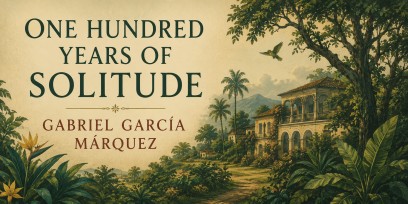
Gabriel García Márquez’s One Hundred Years of Solitude, first published in Spanish in 1967 and reissued in English translation in editions around 2007 to mark the author’s eightieth birthday, remains one of the defining novels of the twentieth century. Born in Aracatuba, Colombia, in 1927, García Márquez drew on the stories of his grandparents, the political upheavals of his country, and the dense oral traditions of the Caribbean coast to create Macondo,
a fictional town that feels both utterly specific and strangely universal. The novel traces seven generations of the Buendía family from the founding of Macondo through its rise, decline, and eventual erasure. Its central insight is that solitude is not merely personal isolation, but a collective condition shaped by memory, repetition, and the refusal to learn from the past. Readers should turn to this book because it offers a sustained examination of how families, communities, and nations trap themselves in cycles of ambition, forgetfulness, and loss, while still finding moments of fierce tenderness and comic invention. In an age of rapid change and short attention spans, the novel functions as a quiet but firm wake-up call about the cost of living without historical awareness.
The narrative begins with one of the most recognizable opening sentences in modern literature: “Many years later, as he faced the firing squad, Colonel Aureliano Buendía was to remember that distant afternoon when his father took him to discover ice” (García Márquez, 2007, p. 1). From this single line the novel moves backward and forward at once, establishing a temporal structure that refuses ordinary chronology. Macondo starts as a small settlement of twenty adobe houses beside a clear river whose stones look like prehistoric eggs. “The world was so recent that many things lacked names, and in order to indicate them it was necessary to point” (p. 1). José Arcadio Buendía, the founder, is a man of restless curiosity whose imagination outruns practical limits. When the gypsy Melquíades arrives with magnets, José Arcadio hears the declaration that “Things have a life of their own, it’s simply a matter of waking up their souls” (p. 2). He later announces to his children, with solemn certainty, “The earth is round, like an orange” (p. 5). These early episodes establish the novel’s blend of the everyday and the extraordinary. Melquíades also introduces a telescope and proclaims, “Science has eliminated distance. In a short time, man will be able to see what is happening in any place in the world without leaving his own house” (p. 3). The statement captures both the promise and the irony of progress that will later overwhelm Macondo.
Úrsula Iguarán, José Arcadio’s wife and cousin, supplies the novel’s practical and moral centre. When the family considers leaving the settlement, she insists they stay because a child has already been born there. José Arcadio replies, “A person does not belong to a place until there is someone dead under the ground” (p. 13). The exchange foreshadows the entire arc of the story: belonging is purchased through death, and death keeps returning in new forms. The family grows. Sons and daughters appear, each carrying names that will repeat across generations: Aureliano, José Arcadio, Amaranta, Remedios. The repetition of names is not decorative. It signals the novel’s deeper argument that history inside the family is a machine of unavoidable repetition. Pilar Ternera, who reads cards and later becomes a matriarch of a different sort, observes that the Buendía line is “a machine with unavoidable repetitions, a turning wheel that would have gone on spilling into eternity were it not for the progressive and irremediable wearing of the axle” (p. 402).
Civil war arrives. Colonel Aureliano Buendía organizes thirty-two-armed uprisings and loses every one of them. He fathers seventeen sons by seventeen different women, all of whom are later hunted down. The wars leave him hollow. In one exchange he tells a fellow officer that he has come to realise he is fighting out of pride rather than ideology. The admission strips the conflict of any romantic gloss and leaves the ground reality of political violence exposed. Meanwhile the town expands, contracts, and suffers plagues of insomnia and forgetfulness. During the insomnia plague people begin labelling every object so they will not forget its name or use. The episode is both comic and chilling: when memory fails, language itself becomes a fragile scaffold holding reality together.
Love in the novel is rarely simple. “Love is a disease,” one-character thunders when a relative proposes marriage to the daughter of an enemy (p. 68). Yet the same book insists, through Úrsula and others, that “There is always something left to love” (p. 162). The most intense attachments often end in isolation. Amaranta carries her virginity and her bitterness to the grave. Remedios the Beauty ascends into the sky while folding sheets. Aureliano Segundo and Petra Cotes discover a late, shared solitude that feels almost like paradise after years of excess. The final Aureliano, Aureliano Babilonia, falls into an incestuous relationship with his aunt Amaranta Úrsula. Their child is born with a pig’s tail, fulfilling the old family fear. As the last pages unfold, Aureliano Babilonia deciphers the parchments left by Melquíades and understands that the entire history of Macondo has been written in advance. “He began to decipher the instant that he was living, deciphering it as he lived it, prophesying himself in the act of deciphering the last page of the parchments, as if he were looking into a speaking mirror” (p. 416). The closing lines seal the argument: “Before reaching the final line, however, he had already understood that he would never leave that room, for it was foreseen that the city of mirrors (or mirages) would be wiped out by the wind and exiled from the memory of men at the precise moment when Aureliano Babilonia would finish deciphering the parchments, and that everything written on them was unrepeatable since time immemorial and forever more, because races condemned to one hundred years of solitude did not have a second opportunity on earth” (p. 417).
Other lines linger with equal force. “The secret of a good old age is simply an honorable pact with solitude” (p. 204). “A person doesn’t die when he should, but when he can” (p. 248). “It’s enough for me to be sure that you and I exist at this moment” (p. 348). “Wherever they might be they always remember that the past was a lie, that memory has no return, that every spring gone by could never be recovered, and that the wildest and most tenacious love was an ephemeral truth in the end” (p. 410). Úrsula, near the end of her long life, confuses past and present so thoroughly that “She finally mixed up the past with the present in such a way that in the two or three waves of lucidity that she had before she died, no one knew for certain whether she was speaking about what she felt or what she remembered” (p. 348). One-character returns from death because “He really had been through death, but he had returned because he could not bear the solitude” (p. 50). Another declares with bitter clarity, “Bad luck doesn’t have any chinks in it... I was born a son of a bitch and I’m going to die a son of a bitch” (p. 372). A visiting intellectual observes, “The world must be all fucked up when men travel first class and literature goes as freight” (p. 322). After a failed search for feeling, a character makes “one last effort to search in his heart for the place where his affection had rotted away, and he could not find it” (p. 335). Two lovers are so inseparable that “They were so close to each other that they preferred death to separation” (p. 380). Úrsula, watching a later generation’s schemes, confirms “that time was going in a circle” (p. 226). These twenty-four quotations, woven through the narrative and cited with page references from the 2007 English edition, do not merely decorate the story; they carry its central claims about time, memory, love, and the impossibility of escape from certain inherited patterns.
The novel’s strengths are considerable. Its research into Colombian history (the banana massacre, the endless civil wars, the arrival of the railway and the multinational company) is absorbed so thoroughly that the historical material never feels bolted on. The prose, in Gregory Rabassa’s translation, moves with a steady, conversational rhythm that can shift from high lyricism to dry humour without strain. The handling of time remains one of the book’s technical triumphs: past, present, and future occupy the same sentence, and the reader learns to accept that arrangement as natural. The characterisation of Úrsula is especially fine; she is the one figure who sees the circularity clearly yet continues to act with stubborn practicality. The comic set pieces (the insomnia plague, the rain that lasts four years, eleven months and two days, the ascent of Remedios) never undercut the underlying seriousness.
Weaknesses exist. The sheer number of characters and the repetition of names can leave readers momentarily lost, particularly in the middle sections. Female characters other than Úrsula and Pilar Ternera sometimes function more as embodiments of desire or purity than as fully independent agents, a limitation that later feminist readings have noted. The novel’s treatment of political violence, while unflinching, offers little in the way of concrete solutions beyond the recognition that ideology alone cannot redeem a society trapped in solitude. Intersectional analysis of class, race, and gender is present in the texture of the narrative but not always articulated with the explicitness a contemporary reader might expect. These gaps do not diminish the book’s achievement, yet they are part of the ground reality of a novel written in the mid-1960s.
Why Indian Youth Readers Must Read This Book
Indian young people today face an education system that still leans heavily on rote learning, a job market that rewards narrow specialisation, and a set of societal expectations that can feel as repetitive and inescapable as the Buendía family curse. Entrance examinations, coaching centres, and the relentless pressure to secure a stable post create their own form of solitude: students study the same material in the same way year after year, often without space to connect knowledge to experience. One Hundred Years of Solitude offers a different model of attention. It insists that history is not a list of dates to be memorised but a living pattern that repeats until someone chooses to break it. The insomnia plague, in which people forget the names and uses of ordinary objects, is an almost perfect metaphor for an education that fills the mind with information while draining it of meaning. When the inhabitants of Macondo must label every cow and every door, the scene feels uncomfortably close to the ground reality of students who can recite formulas yet struggle to explain why the formulas matter.
The novel also speaks to the family pressures that many Indian youths navigate. Parental expectations, the weight of previous generations’ sacrifices, and the quiet fear of bringing shame on the household echo the Buendía obsession with avoiding the birth of a child with a pig’s tail. The book does not offer easy rebellion; it shows the cost of both submission and rupture. Colonel Aureliano’s endless wars illustrate how ideological purity can become another form of solitude. In a country where political and social debates often harden into opposing camps, the novel’s refusal to romanticise either side is a useful corrective. It suggests that real change requires more than slogans; it requires the difficult work of remembering accurately and refusing to let memory become nostalgia or propaganda.
Job market pressures push many young Indians into careers chosen for security rather than inclination. The Buendías who invent, invent, invent and then watch their inventions gather dust provide a cautionary picture of innovation without purpose. At the same time, the novel’s moments of pure delight (the discovery of ice, the sudden flowering of love in unlikely places) remind readers that life is not only a race to keep playing catch-up with peers or with economic indicators. The final image of a town erased from memory because its people never learned from their own story is a stark warning. For a generation that lives much of its life online, where memory is outsourced to devices and history arrives in thirty-second clips, the book’s demand for sustained, patient attention feels almost radical. Reading it slowly, allowing the repetitions to accumulate meaning rather than frustration, is itself a small act of resistance against the culture of speed.
The novel does not pretend that solitude can be abolished by individual will alone. It shows solitude as a social and historical condition. Yet it also insists that recognition is the first step toward any possible exit. Indian youth who absorb that lesson may find themselves better equipped to examine the cycles in their own families, institutions, and public life. They may also discover, as the book quietly demonstrates, that even inside long stretches of isolation there remain pockets of humour, stubborn care, and the simple conviction that “There is always something left to love” (p. 162).
In the end One Hundred Years of Solitude stands as both a local Colombian saga and a universal meditation on how human beings invent and then become trapped by their own stories. Its 2007 English editions made the text newly available to another generation of readers at a moment when the author himself was reflecting on a long career. The book does not solve the problems it diagnoses. It does something rarer: it makes those problems visible in language so precise and so strange that the visibility itself becomes a form of hope. Readers who finish the final page and sit for a moment with the knowledge that Macondo has been wiped from the memory of men will carry that knowledge into their own cities and families. Whether they choose to break the circle or simply to see it more clearly is left to them. The novel has done its work by showing, without sentimentality and without despair, what one hundred years of solitude actually look like, and what it costs to live inside them.