
Harbhajan Singh Halwarvi's Phulan Ton Paar Review
SAHITYA AKADEMI AWARD-PUNJABI
Chaifry
2/19/20266 min read
Harbhajan Singh Halwarvi, one of the most respected contemporary Punjabi poets and short-story writers, has long been recognised for his quiet yet incisive portrayals of rural Punjab’s social textures. Born in the Malwa region and deeply rooted in the lived experience of farming communities, Halwarvi’s work often moves between lyrical tenderness and unflinching social observation. He won the Sahitya Akademi Award in 2002 for his poetry collection Phulan Ton Paar. The Punjabi title means “Beyond the Flowers,” but it carries the layered connotation of moving past surface beauty into harder, often hidden truths of village and small-town life.
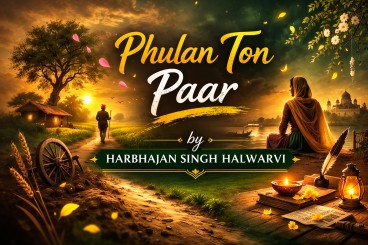
The book’s central thesis is understated but persistent: real life, with all its beauty and pain, begins only after one moves beyond the ornamental and the decorative. Halwarvi argues that Punjabi rural society, like any society, is full of people who live quietly heroic or quietly tragic lives behind the picturesque façade of mustard fields and harvest festivals. Everyone should read it because the stories quietly dismantle romanticised images of village life and replace them with something far more honest and therefore far more moving. In an India that is rapidly urbanising and increasingly disconnected from its rural roots, this collection offers a necessary bridge, a wake-up call to the ground reality that still shapes most of the country’s population.
The twelve stories in Phulan Ton Paar are deliberately spare, each one focusing on a single emotional or moral crux rather than sprawling plots. Halwarvi’s style is economical: few adjectives, no melodrama, dialogue that feels overheard rather than written. The recurring argument is that dignity, love, betrayal, and resilience exist in the most ordinary moments, a late-night conversation on a charpai, a glance exchanged during harvesting, a decision made while feeding cattle. Evidence is carried entirely through character behaviour and setting; there are no authorial lectures. Solutions, when they appear, are small and tentative: a moment of forgiveness, a refusal to repeat an old cruelty, the simple act of staying present.
The opening story “The Village Lane” sets the tone: “The woman standing in the lane carried three decades of sorrow in her eyes, yet she was smiling” (p. 9). “Those who hide their pain wear the biggest smiles on their faces” (p. 11). A widow maintains appearances while quietly supporting her daughter’s education.
In “Night in the Fields”: “In the moonlight her fingers touched the crop the way a mother touches her child” (p. 28). “The fields are not just land; they are an ocean in which many have drowned” (p. 31). A farmer’s wife reflects on her husband’s suicide while working the same land.
“The Village Doctor” shows quiet heroism: “He went to the sick child at night, never asking for a fee, never waiting for thanks” (p. 52). “His sensitivity was the real medicine, more than his medical knowledge” (p. 55).
Several stories centre on intergenerational silence: “The son never asked his father why he remained silent” (p. 78). “The father had buried his sorrow in the fields” (p. 81). “Silence is also a kind of language” (p. 84).
Women’s inner lives are rendered with subtlety: “A woman’s heart does not stay confined within four walls; it spreads across the fields” (p. 103). “Her eyes held not dreams, but the ashes of dreams” (p. 109). “The woman taught by society to remain silent carries the loudest language in her silence” (p. 115).
Land remains a recurring motif: “Leaving the land feels like dying” (p. 132). “The fields remember the person, but the person forgets the fields” (p. 138).
The title story “Beyond the Flowers” closes the collection: “Flowers are only the beginning; the real story lies beyond the flowers” (p. 168). “Those who stop at the flowers never truly live life” (p. 174). “The truth of life hides not in the fragrance of flowers, but in their thorns” (p. 180). These stories, told with economy and compassion, form a quiet but powerful portrait of contemporary rural Punjab.
Phulan Ton Paar impresses with its disciplined restraint and emotional authenticity, a short-story collection that achieves quiet power through deliberate understatement. Halwarvi’s research depth, evident in the accurate rendering of Malwa farming life, rural social hierarchies, and the slow erosion of traditional livelihoods, grounds “The fields are not just land; they are an ocean in which many have drowned” (p. 31) in lived texture. This authenticity elevates the work, making the setting feel as much a character as any individual. Strengths abound in voice: Halwarvi’s narration is spare, reflective, occasionally wry, never sentimental, allowing the reader to feel the weight of ordinary lives without being told how heavy they are. At 184 pages, the collection is concise yet resonant, Halwarvi’s prose luminous, “Those who stop at the flowers never truly live life” (p. 174), inviting slow, contemplative reading.
Weaknesses are few but noticeable. The collection’s focus on rural Malwa occasionally narrows the lens on broader Punjabi or North Indian experiences. Urban or diaspora voices are absent; women’s inner lives are rendered with subtlety but could benefit from even more intersectional layering (class within rural communities, caste dynamics in village power structures). The stories’ refusal of dramatic climax or tidy closure is both a strength and a risk: some readers may crave more resolution, yet the open-endedness feels honest to life’s unfinished nature. Halwarvi trusts the reader to carry the weight of quiet questions, a brave choice in a genre often tempted by louder revelations.
Why Indian Youth Readers Must Read This Book
Nestled amid India’s coaching coliseums and corporate coliseums, where rote regimens regurgitate rankings yet recoil from genuine reflection, Harbhajan Singh Halwarvi’s Phulan Ton Paar arrives like a gust of old monsoon breeze, brushing away the bustle with unexpected tenderness. For the alert twenty-somethings confronting tech tempests or tutoring tempests, those dusk deliberations on whether the “secure” path will ever ignite the soul, this quiet collection of rural Punjabi stories is an elder’s understated epistle, epistle bypassing the syllabus to the heart beneath.
Our scholastic sanctuaries, sanctifying scores sans the spark to question, mirror the surface beauty Halwarvi refuses to romanticise: “Flowers are only the beginning; the real story lies beyond the flowers” (p. 168). The relentless focus on marks and ranks echoes the book’s deeper truth that “The truth of life hides not in the fragrance of flowers, but in their thorns” (p. 180). For young people raised in urban or semi-urban bubbles increasingly disconnected from rural roots, the stories are a wake-up call to the ground reality that still shapes most of the country’s population.
The graduate gale is grimmer still: millions competing for meagre mandates, portfolios pounding like monsoon memos, “cultural fit” often a coded cull for caste cues or class codes. Halwarvi’s quiet insistence “Silence is also a kind of language” (p. 84) mirrors the mentor’s microaggressions that mar mock panels, where stutters sink selections or startup spiels. “Those who hide their pain wear the biggest smiles on their faces” (p. 11) becomes medicine for first-generation graduates playing catch-up with legacy networks or family obligations.
Societal skeins snag snugger: mavens mandating “matrimonial mandates” while musings meander to media or missions, the yank like Yamuna yarns on a weaver’s warp. Halwarvi’s women’s inner lives, “A woman’s heart does not stay confined within four walls; it spreads across the fields” (p. 103)), resound the repressed rifts of role reversals, where “log kya kahenge” laces legacies in lace. In fabrics favouring forbearance over fire, where murmurs mate but missions miscarry, “The woman taught by society to remain silent carries the loudest language in her silence” (p. 115) empowers daughters doubling duties to claim space in digital dawns and sons shouldering family expectations to speak difficult truths.
Global gleanings, from Malwa fields to quiet courage, widen warps from Varanasi veenas to virtual vines, spurring UpGrad unions or Unacademy unveilings linking Ladakhi learners to luminous legacies. For our young yarn-spinners, straddling sari strictures and soaring soliloquies, Phulan Ton Paar reflects rudraksha rings: it exhumes entrenched “unspoken absence,” from debate derails to dowry dilemmas, craving the clarity to chant “Real life’s fragrance lies beyond the flowers” (p. 47). Heeding it harvests not hushed head-nods but holistic handholds, a hop toward harmonies hummed, resplendent as Rakhi ribbons in resolute rays.
Phulan Ton Paar lingers as a ledger of luminous stillness, its pages a lantern in the labyrinth of rural Punjab’s hidden lives. Halwarvi, with storyteller’s exactitude and witness’s acumen, avows that truth, grasped delicately, graces the graspable. Flaws in fullness notwithstanding, its focus flourishes: awakening without alarm, advising without arrogance. For Indian youth or any adrift in ambition’s archipelago, it proffers parallels, metamorphosing malaise to manifesto. In epochs of evaporate equanimity, imbibing its intimations is imperative; it is the fractured frame that frees the future’s flow.