
Niti Aayog 2026 Report: Policy Recommendations
EDUCATION POLICY
Chaifry
7/17/20264 min read

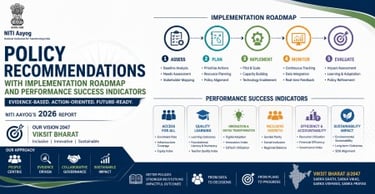
Chapter V of the NITI Aayog report, titled "Policy Recommendations with Implementation Roadmap and Performance Success Indicators," outlines a comprehensive blueprint for transforming school education in India. Formulated from the insights of the National Workshop on Quality Education (February 2025) and aligned with the National Education Policy (NEP) 2020, it establishes a phased roadmap ("Sushikshit Bharat Abhiyaan").
The chapter is structured around two core pillars: Systemic Recommendations and Academic Recommendations, covering structural reforms, infrastructure, governance, teacher development, equity, pedagogy, foundational learning, vocational education, ECCE, and responsible use of AI. It also showcases inspiring success stories and scalable models from states like Rajasthan, Gujarat, Karnataka, and others, providing practical guidance for policymakers and educators to achieve quality education for every child on the path to Viksit Bharat @2047.
I. Core Systemic Recommendations
1. Structural Continuity & Resource Efficiency
Transition to a Cylindrical Structure: Reorganize India's schooling network from a pyramidal model (heavily dominated by standalone primary schools that drop off sharply at secondary levels) to a cylindrical configuration. This prioritizes composite schools (Grades 1–10/1–12) to minimize transitional dropout points.
Operationalizing School Complexes: Establish school complexes (grouping a secondary/senior secondary school with lower-grade neighbor schools within a 5–10 km radius) to efficiently share resources like science/ICT labs, libraries, sports facilities, and subject-specific teachers.
2. Infrastructure Saturation & Digital Enablement
Universal Foundational Facilities: Execute a time-bound push to achieve 100% saturation in basic utilities (WASH, electricity, functional separate toilets, and ramps/accessibility features for CwSN), with progress verified via GIS and UDISE+ mapping.
Digital Integration: Target a minimum of one functional digital classroom per secondary school. Transition from mere hardware delivery to establishing open, interoperable Digital Public Infrastructure (DPI) to support blended learning.
3. Governance, Administration, & Community Accountability
Administrative Reform: Address block- and district-level education department vacancies (which routinely stand as high as 50–60%) and establish State and District Task Forces on School Quality to ensure cross-departmental coordination.
Reframing School Supervision: Move from traditional, compliance-driven checklist inspections to continuous developmental mentorship using frameworks like the School Quality Assessment and Assurance Framework (SQAAF).
Empowering SMCs: Reinforce School Management Committees (SMCs/SDMCs) with simplified, standard templates for bottom-up School Development Plans (SDPs).
4. Teacher Workforce & Professional Development
Deployment & Time-on-Task Governance: Establish State-level Planning Cells and dashboards to coordinate surplus-deficit mapping and restrict non-teaching duties during instructional hours.
Pre-Service & In-Service Training: Modernize Teacher Education Institutions (TEIs) and introduce practice-based learning with Model Practice Schools attached to DIETs.
5. Promoting Equity & Inclusion
Targeted Support for SEDGs: Provide customized academic, financial, and socio-emotional assistance to Socially and Economically Disadvantaged Groups (SEDGs) through mentor-mentee mapping, conditional cash transfers, and Eklavya Model Residential Schools (EMRS).
Dropout Prevention and Early Warning Systems (EWS): Flag "at-risk" students in school registers using indicators such as attendance anomalies and academic stagnation.
Inclusive Environments: Overcome physical and pedagogical barriers for children with special needs (CwSN) by distributing assistive tech and scaling accessible learning repositories like DAISY (Digitally Accessible Information System).
II. Core Academic Recommendations
1. Pedagogy & Foundational Learning
Mastery Over Syllabus Coverage: Shift the academic paradigm from rigid textbook completion to foundational competency-based instruction using Teaching-at-the-Right-Level (TaRL).
Extending FLN: Scale Foundational Literacy and Numeracy (FLN) structures under NIPUN Bharat beyond Grade 3, reinforcing reading and math competencies as a continuum into Grades 4–6.
2. Contextualization & Assessment
Localized Curriculum: Localize instructional materials with regional illustrations, languages, and dialects to make learning relatable, while organizing flexible, modular formats for migratory/mobile groups.
Formative and Competency-Based Evaluation: Restructure summative assessments to include a minimum of 30% application- and reasoning-based questions, shifting focus from memorization to critical analysis.
3. Holistic Health, Physical Fitness, & Well-being
Holistic Growth integration: Mandate 30–45 minutes of structured daily physical activity (PE, yoga, sports) and incorporate fitness metrics into the Holistic Progress Card (HPC).
Socio-Emotional Learning (SEL): Standardize mental health and counseling support across school ecosystems under the MANODARPAN platform, designating trained "Well-being Nodal Teachers" in every school.
4. Vocational mainstreaming
Integrated Skilling: Mainstream vocational education from the middle stage (Grade 6) onwards, integrating practical skill courses aligned with the National Skills Qualifications Framework (NSQF) and the National Credit Framework (NCrF).
5. Strengthening ECCE & AI Integration
ECCE Integration: Link Anganwadis and Balvatikas systematically with primary schools to build transition-readiness bridge modules (ages 3–8).
Responsible AI Adoption: Introduce foundational AI awareness and computational thinking from the upper-primary stage, balanced with cognitive-safety protocols to preserve student attention and critical reasoning skills.
III. Notable State Good Practices & Case Studies
The report highlights multiple successful, scalable models piloted across various states:
Rajasthan:
School Rationalization: Consolidated over 5,800 under-enrolled primary and upper-primary schools into resource-dense, multi-grade composite schools (Adarsh Vidyalayas).
Shala Swasthya Parikshan: Digitally screened over 75 lakh students across 70+ health parameters using a mobile application.
Mukhyamantri Shikshit Rajasthan Abhiyan: Implemented the Shikshak app, utilizing Optical Character Recognition (OCR) and AI to instantly evaluate and analyze student competency testing.
Nagaland:
Lighthouse School Complexes (LSCs): Built a hub-and-spoke model across 16 districts for shared facilities (libraries, CwSN-friendly infrastructure, and teacher professional circles).
Performance Incentive Grants (PIG): Empowered over 1,900 SMCs with financial autonomy linked to performance reviews.
Gujarat:
Gyankunj Initiative: Digitalized 1,609 government primary schools, deploying interactive smart classrooms and virtual labs for 2.85 lakh students in Grades 5–8.
Karnataka:
Kalika Chetarike: Redesigned classroom instruction for Classes 1–9 around activity-based, competency-centric pathways to support post-pandemic learning recovery.
Uttar Pradesh:
Graded Learning Programme (GLP): Scaled TaRL-based grouping to transition over 17 lakh children in Grades 4–5 to basic reading levels.
Mission Sunehra Kal: Revamped 864 Anganwadi centers in Saharanpur with play-based learning material and BALA (Building as Learning Aid) designs.
Manipur:
Comic Textbooks: Introduced visually enriched, story-driven textbooks to simplify abstract concepts in Math, Science, and Languages for Grades 1–8.
Unique Selling Proposition (USP) Initiative: Engaged local artisans to teach traditional crafts (pottery, weaving, gardening) to middle schoolers.
The comprehensive policy recommendations and implementation roadmaps outlined in Chapter V of NITI Aayog's report represent a transformative and highly promising vision for the school education system in India. By shifting the paradigm from mere physical expansion to qualitative saturation and systemic consolidation, this blueprint paves a viable path toward achieving the aspirations of Viksit Bharat @2047.
The proposed integration of early childhood care, composite schooling, and vocational education successfully dismantles long-standing structural divides, establishing a seamless, inclusive, and future-ready learning continuum. Furthermore, the commitment to modernizing teacher capacity, institutionalizing competency-based assessments, and responsibly leveraging artificial intelligence ensures that Indian classrooms will become vibrant centers of curiosity, critical thinking, and innovation.
Backed by rigorous, data-driven governance frameworks and successful grassroots practices from various states, this roadmap inspires immense confidence that India can successfully elevate educational quality and equity, empowering its vast human capital to lead purposeful lives and thrive on the global stage.
References
NITI Aayog. (2026). School Education System in India: Temporal Analysis and Policy Roadmap for Quality Enhancement. Education Division, NITI Aayog.