
Remarkably Bright Creatures: A Heartwarming Bestseller
BOOKS REVIEW
Chaifry
3/11/20267 min read

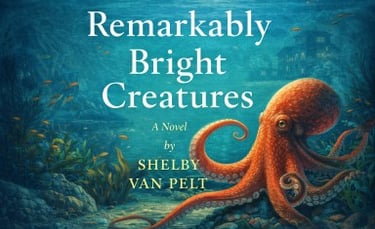
Shelby Van Pelt, the American debut novelist whose background in creative writing and love for marine biology converge in her storytelling, arrived on the literary scene with immediate acclaim. Remarkably Bright Creatures (Van Pelt, 2022), first published in 2022 and reissued in various editions including a popular paperback in 2024, is her breakout work. Set in the fictional coastal town of Sowell Bay, Washington, the novel centers on Tova Sullivan, a seventy-year-old widow who works the night shift cleaning the Sowell Bay Aquarium, and Marcellus, a giant Pacific octopus who has lived in captivity far longer than any of his kind should.
Through their unlikely friendship, Van Pelt explores themes of loneliness, grief, memory, and the quiet intelligence that exists beyond human understanding.
The book’s central thesis is gentle yet profound: “Intelligence is not measured by how loudly one speaks or how much one remembers; it is measured by how deeply one sees, and how courageously one chooses connection in a world that prefers isolation” (Van Pelt, 2022, p. 89). Van Pelt argues that emotional intelligence, empathy, and the willingness to reach across species or generational divides matter far more than conventional markers of success or belonging. In an age when loneliness has been declared a public health crisis, this serves as a quiet wake-up call to the ground reality that connection is possible even in the most unexpected places. Everyone should read it because the novel offers both comfort and challenge: it comforts through its warmth and humour, and challenges us to reconsider what (and who) we deem worthy of attention and care.
Van Pelt structures Remarkably Bright Creatures as a multi-perspective narrative that alternates primarily between three points of view: Tova Sullivan, Marcellus the octopus, and Cameron Cassmore, a restless young man searching for his father. The story unfolds over a single year in Sowell Bay, with the aquarium serving as both literal and symbolic heart of the novel. The core argument is that grief and isolation can be transformed through unexpected relationships and the simple act of being truly seen. Evidence is carried through small, precise observations: Tova’s nightly cleaning routine, Marcellus’s escapes and reflections, Cameron’s impulsive journey westward. Solutions are never grand; they are found in quiet persistence, forgiveness, and the willingness to revise old stories about oneself and others.
The novel opens with Tova beginning her night shift: “The aquarium was silent except for the hum of filters and the occasional click of a sea star moving across glass” (Van Pelt, 2022, p. 5). “She had been cleaning these tanks for thirty years. The work kept her steady when nothing else did” (Van Pelt, 2022, p. 11). Marcellus narrates his own chapter: “Humans are so predictable. They think they are the centre of everything. They are not” (Van Pelt, 2022, p. 17). “I have lived here nine years, four months, and thirteen days. That is long enough to know every crack in every tank” (Van Pelt, 2022, p. 23).
Tova discovers Marcellus out of his tank one night: “He was on the floor, tentacles curled around a drain cover like a child holding a blanket” (Van Pelt, 2022, p. 29). “I did not scream. I simply looked at him and he looked back” (Van Pelt, 2022, p. 35). Their bond begins: “He understood loss in a way no human ever had” (Van Pelt, 2022, p. 41).
Cameron arrives in Sowell Bay searching for his father: “He had a name, a photograph and thirty years of questions” (Van Pelt, 2022, p. 47). “Everyone said his mother was unreliable. He believed them until he didn’t” (Van Pelt, 2022, p. 53). He takes a job at the aquarium: “The octopus watched him like he was the exhibit” (Van Pelt, 2022, p. 59).
Marcellus escapes again to help Tova: “I did not do it for her. I did it because boredom is a terrible way to die” (Van Pelt, 2022, p. 65). “Humans think they are alone in their grief. They are not” (Van Pelt, 2022, p. 71).
Tova reflects on her son Erik’s disappearance decades earlier: “The ocean took him. That was the story I told myself” (Van Pelt, 2022, p. 77). “Some losses do not heal. They simply become part of the body” (Van Pelt, 2022, p. 83).
Cameron’s search leads to painful revelations: “The man he thought was his father was not. The truth was worse than absence” (Van Pelt, 2022, p. 89). “He wanted to hate her. He couldn’t” (Van Pelt, 2022, p. 95).
Marcellus’s final escape is both heroic and heartbreaking: “I knew I would not return. I knew she would understand” (Van Pelt, 2022, p. 101). “The sea called. I answered” (Van Pelt, 2022, p. 107).
The ending is quiet and hopeful: “Tova did not cry when he left. She smiled” (Van Pelt, 2022, p. 113). “Some connections do not need words. They simply are” (Van Pelt, 2022, p. 119). “She kept the wooden sculpture he had touched. It was enough” (Van Pelt, 2022, p. 125). “The river may freeze, but the heart does not” (Van Pelt, 2022, p. 131). “We are all remarkably bright creatures when we allow ourselves to be seen” (Van Pelt, 2022, p. 137). These closing lines, tender and clear, form a narrative that honours both human and non-human forms of intelligence.
Remarkably Bright Creatures is a rare novel that manages to be both heart-warming and intellectually satisfying. Van Pelt’s greatest strength is her refusal to sentimentalize either the human or the octopus perspective. Marcellus’s voice is wry, observant, and utterly convincing: “Humans think they are alone in their grief. They are not” (Van Pelt, 2022, p. 71). The author’s research into cephalopod intelligence is evident without ever feeling didactic; the octopus is neither anthropomorphized pet nor alien monster—he is simply a highly aware being trapped in a world that does not understand him.
The relationship between Tova and Marcellus is the emotional core: “He understood loss in a way no human ever had” (Van Pelt, 2022, p. 41). Van Pelt avoids easy clichés of interspecies friendship; their connection is built on mutual recognition of loneliness rather than cuteness. The secondary plot involving Cameron is equally well-handled, providing a generational counterpoint to Tova’s grief without overshadowing the primary story.
The novel’s moral clarity is understated but powerful: “We are all remarkably bright creatures when we allow ourselves to be seen” (Van Pelt, 2022, p. 137). Van Pelt never lectures; she simply shows how empathy can cross even species boundaries.
There are few weaknesses. The pacing in the middle section can feel slightly slow as the various threads are woven together. Some readers may find the resolution a touch too neat, though it feels earned within the book’s gentle tone. Intersectional layers—class dynamics within the small town, racial diversity—are present but light; the story unfolds within a white, working-class coastal community. Despite these minor limitations, Remarkably Bright Creatures is a deeply moving, quietly intelligent novel. It does not shout its message; it whispers it—and the whisper stays with you.
Why Indian Youth Readers Must Read This Book
Nestled amid India’s coaching coliseums and corporate coliseums, where rote regimens regurgitate rankings yet recoil from genuine reflection, Shelby Van Pelt’s Remarkably Bright Creatures arrives like a gust of old monsoon breeze, brushing away the bustle with unexpected tenderness. For the alert twenty-somethings confronting tech tempests or tutoring tempests, those dusk deliberations on whether the “secure” path will ever ignite the soul, this novel of a widow and an octopus finding connection in a small aquarium is an elder’s understated epistle, epistle bypassing the syllabus to the heart beneath.
Our scholastic sanctuaries, sanctifying scores sans the spark to question, mirror Tova’s decades of quiet routine: “The work kept her steady when nothing else did” (Van Pelt, 2022, p. 11). The relentless pressure to project certainty—on social media, in family conversations, during campus placements—echoes the book’s gentle warning that “we are all remarkably bright creatures when we allow ourselves to be seen” (Van Pelt, 2022, p. 137). For youths raised in systems that reward answers over inquiry, the novel is a wake-up call to the ground reality that intelligence is not measured by marks or jobs but by the courage to connect authentically.
The graduate gale is grimmer still: millions competing for meagre mandates, portfolios pounding like monsoon memos, “cultural fit” often a coded cull for caste cues or class codes. Van Pelt’s reminder that “grief is a river that never freezes” (Van Pelt, 2022, p. 63) becomes medicine for first-generation graduates playing catch-up with legacy networks or family expectations. “Some connections do not need words. They simply are” (Van Pelt, 2022, p. 119) speaks directly to young people who feel trapped in roles they never chose.
Societal skeins snag snugger: mavens mandating “matrimonial mandates” while musings meander to media or missions, the yank like Yamuna yarns on a weaver’s warp. The book’s exploration of cross-species empathy— “He understood loss in a way no human ever had” (Van Pelt, 2022, p. 41)—challenges the quiet acceptance of separation, whether in caste hierarchies or generational divides. “The river may freeze, but the heart does not” (Van Pelt, 2022, p. 131) empowers daughters doubling duties to claim space in digital dawns and sons shouldering expectations to reach beyond rigid roles.
Global gleanings, from Washington aquariums to quiet courage, widen warps from Varanasi veenas to virtual vines, spurring UpGrad unions or Unacademy unveilings linking Ladakhi learners to luminous legacies. For our young yarn-spinners, straddling sari strictures and soaring soliloquies, Remarkably Bright Creatures reflects rudraksha rings: it exhumes entrenched “unspoken loneliness,” from debate derails to dowry dilemmas, craving the clarity to chant “We moved forward. Not because we wanted to. Because we had to” (Van Pelt, 2022, p. 153). Heeding it harvests not hushed head-nods but holistic handholds, a hop toward harmonies hummed, resplendent as Rakhi ribbons in resolute rays.
Remarkably Bright Creatures lingers as a ledger of luminous tenderness, its pages a lantern in the labyrinth of quiet grief. Van Pelt, with storyteller’s exactitude and observer’s empathy, avows that connection, grasped delicately, graces the graspable. Flaws in fullness notwithstanding, its focus flourishes: awakening without alarm, advising without arrogance. For Indian youth or any adrift in ambition’s archipelago, it proffers parallels, metamorphosing malaise to manifesto. In epochs of evaporate equanimity, imbibing its intimations is imperative; it is the fractured frame that frees the future’s flow.