The $50B U.S. aid budget: what’s in it for development
GLOBAL AFFAIRS, POLITICAL ECONOMY, GOVERNANCE & INSTITUTIONSPOLITICS
Chaifry
1/27/20269 min read
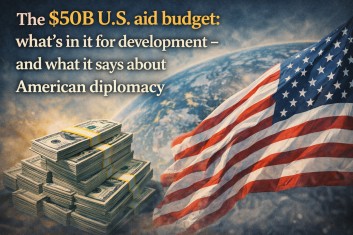
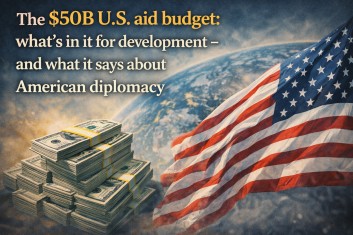
The $50B U.S. aid budget: what’s in it for development - and what it says about American diplomacy
A grounded-theory, policy-text analysis of the FY2026 State-Foreign Operations compromise, the rebrand of foreign assistance under ‘America First’, and the soft-power bargain being renegotiated at Davos
Executive summary
A roughly $50 billion compromise appropriation for the Department of State, foreign assistance, and related programs has become a litmus test for what ‘American leadership’ means in 2026: less about expansive liberal internationalism, more about a constrained, transactional, and security-forward bargain that still cannot fully abandon life-saving development commitments.
The package is widely described as a rebuke to proposals for a near-halving of foreign assistance.
In practice, it does something more complex: it narrows the purpose of aid, consolidates accounts, and increases executive flexibility through new funding mechanisms, while Congress preserves a floor under a small set of high-visibility programs (global health and humanitarian assistance) that generate clear results and reputational returns.
Read as diplomacy, the bill is neither a simple ‘failure’ nor a clean ‘rise.’ It is evidence of institutional resilience (Congress protecting international affairs capacity), and evidence of a sharper U.S. posture where assistance is framed as leverage - on migration cooperation, U.N. voting alignment, countering rivals, and burden-sharing.
Using a grounded-theory approach - open coding of legislative text, committee reports, public statements, and contemporary Davos discourse - four recurring categories emerge: (1) security-first rebranding, (2) flexibility versus guardrails, (3) multilateral push-pull, and (4) legitimacy through measurable life-saving results.
The core theory that best fits the data is what this article calls bounded soft power: U.S. aid is being redesigned to keep the diplomatic upside of attraction and credibility, but inside tighter political constraints that prioritize short-cycle national interest narratives, visible returns, and executive discretion.
For development practitioners, the headline is not only the topline number. The more consequential shift is account structure and governance: consolidation of economic assistance lines, new flexible funds, and the continued politicization of multilateral contributions. These design choices will shape predictability, sector mix, and the incentives driving implementation.
1. The question behind the number
‘$50 billion’ sounds like a budget story. It is - but it’s also a story about what the United States thinks diplomacy is for, and what it is willing to fund in order to stay influential when domestic politics pulls inward.
The FY2026 State-Foreign Operations (SFOPS) compromise emerged in a shutdown-avoidance context, with appropriators seeking to finalize outstanding bills ahead of a late-January deadline. In that environment, the international affairs bill became a proxy fight about three overlapping questions: (1) is development assistance a global public good or a subsidy, (2) who should control it - Congress, agencies, or the White House, and (3) what role should multilateral institutions play if Washington is more skeptical of them.
The bill also sits inside a wider 2025-26 pattern: renewed executive attempts to withhold, reprogram, or claw back foreign assistance; and a more explicit effort to frame aid as leverage for near-term national priorities rather than long-horizon development partnerships.
2. What is in the $50B package (and what changed)
A practical way to understand the compromise is to separate topline funding, account architecture, and program signal.
2.1 Topline: a cut, but not the cut some wanted
Public summaries of the compromise describe a topline around $50 billion for the National Security, Department of State, and Related Programs (NSRP) appropriations bill - roughly a 16% reduction relative to the prior year’s enacted level in that structure. At the same time, it is widely reported as substantially higher than the Administration’s request, which sought far deeper cuts (approaching a near-halving of foreign assistance in some framings).
2.2 Architecture: consolidation and executive flexibility
The most structural change is not a single line item. It is consolidation: multiple economic and development assistance accounts are merged into fewer, larger buckets, then paired with flexible authorities. That kind of re-plumbing matters because it changes the incentive structure. It becomes easier to move money toward short-cycle foreign policy opportunities and harder for Congress and implementing partners to plan multi-year development trajectories.
One emblem of this shift is the creation of a flexible ‘America First Opportunity Fund’ concept in legislative text - up to $1.7 billion designated from selected accounts to respond to crises, engage strategic partners, and implement an America First foreign policy.
2.3 Program signals: what the bill chooses to keep visible
Even in a cutting environment, Congress tends to protect what is (a) politically legible, (b) measurable, and (c) morally difficult to abandon. Global health and humanitarian assistance often meet all three tests. That is why debates around PEPFAR, child survival, vaccine financing, and humanitarian response keep producing bipartisan coalitions, even when the broader aid ecosystem is under pressure.
2.4 A quick schematic
3. U.S. aid as soft diplomacy: a short, rich history
To judge whether today’s aid politics represent diplomatic failure or reinvention, you have to zoom out. U.S. foreign assistance has always been a fusion of moral argument and strategic calculation - and the balance has shifted with each era.
3.1 From Europe’s reconstruction to the birth of ‘development’
After World War II, the Marshall Plan created a template: large-scale economic assistance to stabilize allies, rebuild markets, and shape a geopolitical order. The wager was not charity; it was that prosperity would underwrite democratic stability and reduce the appeal of rival systems.
Truman’s Point Four Program (announced in 1949, funded from 1950) extended the logic to ‘underdeveloped areas,’ emphasizing technical assistance in agriculture, public health, and education - what we would now call capacity building and human development.
3.2 USAID, 1961: development becomes an institution
In 1961, the Foreign Assistance Act reorganized U.S. aid and led to the creation of USAID, consolidating earlier programs under a more coherent development mandate. This institutionalization mattered: it separated (at least on paper) long-run development work from short-run diplomatic bargaining, while still keeping both inside foreign policy.
3.3 Cold War, post-Cold War, and the rise of results narratives
During the Cold War, aid frequently followed alliance logic. After 1990, democratization, market reforms, and humanitarian crises became more prominent drivers. The early 2000s then produced a distinctive shift: big branded initiatives with clear metrics and moral urgency - most notably PEPFAR (2003) and the Millennium Challenge Corporation (2004). These programs helped make aid legible to domestic voters by tying it to measurable outcomes.
3.4 The 2010s-2020s: strategic competition and development finance
By the late 2010s, strategic competition with China shaped aid language more explicitly. The U.S. International Development Finance Corporation (DFC), launched in 2019, reflects a hybrid tool: mobilizing private capital for infrastructure and growth while advancing foreign policy objectives. This is diplomacy by investment rather than grants - and it has increasingly been framed as an ‘alternative’ to Belt and Road financing.
4. The FY2026 moment: Davos discourse, a ‘Board of Peace,’ and aid’s identity crisis
The FY2026 foreign assistance fight is happening in the same season as high-drama diplomacy at Davos. The World Economic Forum’s 2026 theme, ‘A Spirit of Dialogue,’ frames the moment as one of fragmentation and the search for platforms that can still convene rivals.
In that environment, President Trump’s launch of a new ‘Board of Peace’ at Davos - positioned as a conflict-resolution and reconstruction body - became a symbol of how U.S. diplomacy is being recast: away from legacy multilateralism and toward ad-hoc, U.S.-chaired mechanisms with membership fees, branding, and executive control.
Whether the Board of Peace becomes durable or fades, it reveals an appetite for replacing slow institutions with branded initiatives. That impulse is directly relevant to how foreign assistance is being redesigned inside the appropriations bill: consolidate, centralize, move faster, and frame spending as leverage.
5. Method: a grounded-theory reading of U.S. aid politics
This article uses a grounded-theory inspired, desk-based approach. Rather than beginning with a single grand hypothesis (for example, ‘aid cuts mean isolationism’), it treats policy texts, legislative language, committee summaries, and public statements as qualitative data. The analysis uses iterative coding: first identifying recurring phrases and rationales (open coding), then clustering them into categories (axial coding), and finally testing which core category best explains the pattern (selective coding), using constant comparison across sources.
Data sources include: (a) legislative text and committee reports for the FY2026 NSRP/SFOPS bill, (b) public summaries by appropriators and civil-society budget trackers, (c) reporting on foreign assistance freezes and impoundment episodes affecting global health and vaccine finance, and (d) Davos-era diplomacy narratives (WEF official releases and major reporting).
5.1 The codes that keep repeating
6. Findings: the ‘bounded soft power’ bargain
Across sources, one core pattern explains the compromise better than either ‘aid is being cut’ or ‘aid is being saved.’ The pattern is bounded soft power.
Joseph Nye’s core definition is straightforward: soft power is the ability to obtain preferred outcomes through attraction rather than coercion or payment. U.S. development assistance has historically been one of the most concrete factories of attraction: it saves lives, supports institutions, and creates a memory of partnership that outlasts headlines.
But in 2026, that soft power is being bounded - kept, but constrained - by political conditions that show up repeatedly in the bill language and in the public defense of the bill.
Aid must be narratable as national security (countering rivals, stabilizing allies, reducing spillovers).
Aid must be measurable (clear life-saving or crisis-averted metrics that withstand hostile hearings).
Aid must be more steerable by the executive (flexible funds, consolidated accounts, faster reallocations).
Aid must be less multilateral by default (skepticism toward U.N. or IFIs; preference for bilateral leverage).
Aid must signal ‘value for money’ discipline (oversight, inspector general findings, and anti-waste framing).
6.1 Failure or rise of diplomacy? The honest answer is: both
It is a failure in the sense that the development mandate is narrowing and being rhetorically subordinated to short-cycle political goals. When aid is treated as leverage first and partnership second, it becomes harder to sustain country ownership, long-run institution building, and credible multilateral cooperation.
It is also a rise - of a different kind - in the sense that the U.S. is not walking away from the field. Instead, it is redesigning the toolkit: more flexible instruments, more development finance, and more branded diplomatic bodies. The question is whether this redesign preserves the core asset that made U.S. aid strategically powerful in the first place: credibility.
7. What’s in it for development
For partner governments and implementing organizations, ‘what’s in it’ is best read as a mix of opportunity and risk.
7.1 Opportunities
A stronger emphasis on measurable outcomes can push systems toward tighter monitoring, procurement discipline, and delivery at scale - if it is paired with realistic time horizons.
Flexible authorities can allow faster response to shocks (conflict flare-ups, epidemics, climate disasters) when bureaucratic pipelines would otherwise lag.
Development finance tools can unlock infrastructure and private-sector growth where grants are insufficient, especially in energy, logistics, and digital connectivity.
7.2 Risks
Consolidation and flexibility can reduce transparency and predictability, increasing transaction costs and weakening local ownership.
If multilateral contributions are cut or politicized, burden-sharing breaks down and partners face fragmented standards and higher coordination overhead.
Repeated threats to programs like PEPFAR create operational whiplash: staffing disruptions, supply-chain breaks, and avoidable mortality spikes.
The reputational damage from ‘aid as a domestic culture war’ can erode the attraction that soft power depends on, even if dollars continue to flow.
7.3 The global health test case: why PEPFAR and vaccines keep coming back
Global health funding is a recurring stress test because it is where the moral and strategic cases align most cleanly. PEPFAR, for example, is consistently described in official and global health sources as having saved more than 26 million lives over two decades and supporting treatment for more than 20 million people. Those are not abstract numbers. They are governance stability in high-burden contexts, reduced orphanhood, protected workforces, and more resilient health systems.
Vaccine financing is similar. The global immunization ecosystem has saved a massive number of lives over the last half-century, and organizations like Gavi have been a central channel for reaching low-income countries. When the U.S. signals uncertainty or withdrawal, the ‘trust capital’ damage can be larger than the dollar loss, because it triggers co-financing hesitation and procurement delays.
8. Recommendations: keeping development value while meeting political reality
If the political reality is a bounded-soft-power bargain, then the practical question becomes: how do you protect development value inside that bargain, rather than simply mourning what was lost?
9. Conclusion
The FY2026 $50B foreign assistance compromise is not a simple win for development, nor a clean defeat. It is an institutional compromise that keeps a U.S. presence on the global development board while shrinking and reshaping what that presence is meant to accomplish.
If you are looking for the diplomatic meaning, the cleanest summary is this: Congress is still willing to pay for soft power, but only if soft power wears a national security uniform, carries auditable receipts, and can be steered quickly by the executive.
That bargain may hold in the short run. In the long run, the United States will only keep the diplomatic returns of aid if it protects the one thing that makes attraction possible: trust - earned through consistency, humility, and delivery.
References (selected open sources)
Congress.gov: H.R. 4779 (119th Congress), National Security, Department of State, and Related Programs Appropriations Act, 2026 (bill text).
Congress.gov: H. Rept. 119-217 (committee report) on the FY2026 NSRP Appropriations Bill.
House Committee on Appropriations: press releases on FY26 NSRP bill passage in committee.
Congressman Dan Newhouse: press release summarizing FY26 NSRP bill topline and priorities.
U.S. Global Leadership Coalition (USGLC): International Affairs Budget Update (July 2025).
World Economic Forum: Annual Meeting 2026 press release (theme: A Spirit of Dialogue; hashtag #WEF26).
The White House: Board of Peace charter ratification statement (January 22, 2026).
Foreign Policy and Al Jazeera reporting on Board of Peace charter signing at Davos (January 2026).
WHO: statement on PEPFAR risks and lives saved (January 28, 2025).
Gavi: donor profile for the United States and historical contributions.
WHO: global immunization lives-saved release (April 24, 2024).
National Archives: Marshall Plan milestone document (appropriations totals).
Britannica: Point Four Program overview; USAID founding history.
Joseph S. Nye Jr. (Harvard DASH / ANNALS, 2008): Public Diplomacy and Soft Power (definition).
OECD: Official Development Assistance (ODA) definition and coverage pages.