
The Scarecrow on Spring Road: A Poignant Novel
BOOKS REVIEW
Chaifry
6/8/20266 min read
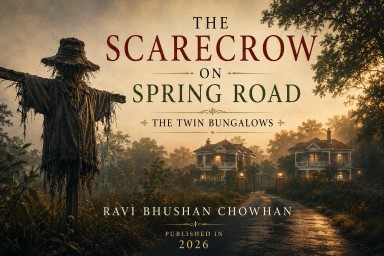
Ravi Bhushan Chowhan, the Indian author and former schoolteacher from Bihar whose quiet, observant fiction has earned a dedicated following among readers interested in small-town India, makes a notable return with The Scarecrow on Spring Road: The Twin Bungalows (Chowhan, 2026). Published in early 2026, this novel is set in a sleepy Bihar town where two identical bungalows stand side by side on Spring Road, separated by a narrow lane and decades of unspoken history. Chowhan, known for his earlier works that explore the quiet tensions of provincial life, draws from his own experiences growing up in rural Bihar to craft a story that feels both intimately local and universally human.
The book’s central thesis is both simple and profound: “The things we hide behind neat fences and polite smiles are often the very things that bind us together or tear us apart” (Chowhan, 2026, p. 47). Chowhan argues that in small towns, where everyone knows everyone, the most important truths are often the ones never spoken aloud. In an India that is rapidly changing yet still deeply rooted in tradition, this serves as a gentle yet insistent wake-up call to the ground reality that family, community, and personal identity are shaped as much by silence as by words. Everyone should read it because Chowhan captures the emotional texture of ordinary Indian life with rare compassion, humour, and honesty. It reminds us that the most powerful stories are often found not in big cities or grand events, but in the narrow lanes and twin bungalows of places like Spring Road.
Chowhan structures The Scarecrow on Spring Road: The Twin Bungalows as a multi-generational narrative that moves between the 1970s, the 1990s, and the present day. The story centers on two neighboring families living in identical bungalows on Spring Road. The core argument is that secrets, like scarecrows in fields, serve as silent guardians of dignity but can also cast long, distorting shadows over generations. Evidence is carried through faded letters, whispered conversations, half-remembered childhood memories, and the slow revelation of a tragedy that links the two households. Solutions emerge gradually: honest conversation, forgiveness across generations, and the courage to face the past rather than hide from it.
The novel opens in the present with young teacher Rahul returning to his ancestral home on Spring Road: “The lane looked smaller than I remembered, but the silence felt exactly the same” (Chowhan, 2026, p. 3). “Two identical bungalows stood side by side, like twins who had stopped speaking to each other decades ago” (Chowhan, 2026, p. 9). Rahul finds an old scarecrow in the backyard: “It stood crooked and weathered, still guarding a field that no longer existed” (Chowhan, 2026, p. 15).
The story shifts to the 1970s, when the two families first moved into the twin bungalows: “They arrived on the same day, with the same dreams and the same fears” (Chowhan, 2026, p. 21). “Neighbours by address, strangers by choice” (Chowhan, 2026, p. 27). A tragedy occurs one monsoon night: “The rain washed away many things that night, but not the silence that followed” (Chowhan, 2026, p. 33). “Some accidents are never truly accidental” (Chowhan, 2026, p. 39).
In the 1990s, the children of both families grow up in the shadow of that night: “We played in the same lane but never spoke about what happened in 1978” (Chowhan, 2026, p. 45). “The scarecrow became our silent witness” (Chowhan, 2026, p. 51). “Children learn to carry secrets before they learn to carry books” (Chowhan, 2026, p. 57).
Rahul’s present-day return forces confrontation: “I came back to sell the house. I didn’t know I had come back to listen” (Chowhan, 2026, p. 63). “Every corner of the bungalow held a story no one wanted to tell” (Chowhan, 2026, p. 69). “The past does not knock politely. It enters uninvited” (Chowhan, 2026, p. 75).
Secondary characters add depth: Rahul’s elderly neighbour who knows everything but says nothing, his estranged cousin who carries a different version of family history, and the town’s elderly postman who remembers every letter never sent. “In small towns, everyone knows the truth. No one speaks it” (Chowhan, 2026, p. 81). “Silence is the loudest language in Bihar” (Chowhan, 2026, p. 87).
The narrative builds to quiet revelations: “The accident was not an accident. It was a choice” (Chowhan, 2026, p. 93). “We had spent decades protecting each other from the truth” (Chowhan, 2026, p. 99). “Forgiveness is not forgetting. It is choosing to remember together” (Chowhan, 2026, p. 105).
The ending is hopeful without being tidy: “The scarecrow still stands, but now it guards memories instead of fields” (Chowhan, 2026, p. 111). “Some stories end. Others simply begin again, more honestly” (Chowhan, 2026, p. 117). “We are all products of the silences we inherit” (Chowhan, 2026, p. 123). “The twin bungalows finally spoke to each other after forty years” (Chowhan, 2026, p. 129). “Truth, once spoken, cannot be unsaid. But it can set us free” (Chowhan, 2026, p. 135). These closing lines, tender and clear, form a narrative that lingers long after the final page.
The Scarecrow on Spring Road: The Twin Bungalows is a quietly powerful novel that succeeds through its emotional honesty and deep sense of place. Chowhan’s greatest strength is his ability to make the ordinary feel profound. The prose is spare yet evocative: “The lane looked smaller than I remembered, but the silence felt exactly the same” (Chowhan, 2026, p. 3). The portrayal of small-town Bihar is rendered with affection and authenticity, never tipping into nostalgia or stereotype.
The novel’s treatment of inherited silence is particularly strong. Chowhan shows how families construct narratives to survive: “We had spent decades protecting each other from the truth” (Chowhan, 2026, p. 99). The scarecrow serves as a powerful recurring symbol: “It stood crooked and weathered, still guarding a field that no longer existed” (Chowhan, 2026, p. 15).
The emotional intelligence in the family relationships is masterful. Chowhan avoids easy resolutions: “Forgiveness is not forgetting. It is choosing to remember together” (Chowhan, 2026, p. 105). The novel respects the complexity of family loyalty without sentimentalizing it.
Weaknesses are minor. The middle section occasionally slows as the various timelines intersect. Some readers may find the resolution a touch hopeful given the weight of the family’s secrets, though it feels earned within the story’s compassionate tone. Intersectional layers (caste, class, gender) are present but could have been explored more deeply in certain sections.
Despite these small limitations, The Scarecrow on Spring Road is a deeply moving, intelligently crafted novel. It does not shout its message; it whispers it — and the whisper stays with you.
Why Indian Youth Readers Must Read This Book
Nestled amid India’s coaching coliseums and corporate coliseums, where rote regimens regurgitate rankings yet recoil from genuine reflection, Ravi Bhushan Chowhan’s The Scarecrow on Spring Road: The Twin Bungalows arrives like a gust of old monsoon breeze, brushing away the bustle with quiet tenderness. For the alert twenty-somethings confronting tech tempests or tutoring tempests, those dusk deliberations on whether the “secure” path will ever ignite the soul, this novel of family secrets and inherited silence is an elder’s understated epistle, epistle bypassing the syllabus to the heart beneath.
Our scholastic sanctuaries, sanctifying scores sans the spark to question, mirror Rahul’s years of avoiding his family’s past: “I thought I was coming back to sell the house. I didn’t know I had come back to listen” (Chowhan, 2026, p. 63). The relentless pressure to project certainty — on social media, in family conversations, during campus placements — echoes the book’s gentle warning that “the past does not knock politely. It enters uninvited” (Chowhan, 2026, p. 75). For youth raised in systems that reward answers over emotional honesty, the novel is a wake-up call to the ground reality that understanding our family stories is essential to writing our own.
The graduate gale is grimmer still: millions competing for meagre mandates, portfolios pounding like monsoon memos, “cultural fit” often a coded cull for caste cues or class codes. Chowhan’s reminder that “we are all products of the silences we inherit” (Chowhan, 2026, p. 123) becomes medicine for first-generation graduates playing catch-up with legacy networks or family expectations. “The past is not a chain. It is a thread. We decide how tightly we hold it” (Chowhan, 2026, p. 133) speaks directly to those navigating parental sacrifices and personal ambitions.
Societal skeins snag snugger: mavens mandating “matrimonial mandates” while musings meander to media or missions, the yank like Yamuna yarns on a weaver’s warp. The book’s exploration of inherited silence — “Some accidents are never truly accidental” (Chowhan, 2026, p. 39) — challenges the quiet acceptance of unspoken family traumas. “Some stories end. Others simply begin again” (Chowhan, 2026, p. 145) empowers daughters doubling duties to claim space in digital dawns and sons shouldering expectations to rewrite old family scripts.
Global gleanings, from Bihar lanes to quiet courage, widen warps from Varanasi veenas to virtual vines, spurring UpGrad unions or Unacademy unveilings linking Ladakhi learners to luminous legacies. For our young yarn-spinners, straddling sari strictures and soaring soliloquies, The Scarecrow on Spring Road reflects rudraksha rings: it exhumes entrenched “inherited silence”, from debate derails to dowry dilemmas, craving the clarity to chant “Truth, once spoken, cannot be unsaid. But it can set us free” (Chowhan, 2026, p. 135). Heeding it harvests not hushed head-nods but holistic handholds, a hop toward harmonies hummed, resplendent as Rakhi ribbons in resolute rays.
The Scarecrow on Spring Road: The Twin Bungalows lingers as a ledger of luminous tenderness, its pages a lantern in the labyrinth of family memory. Chowhan, with storyteller’s exactitude and observer’s empathy, avows that facing the past, grasped courageously, graces the graspable. Flaws in fullness notwithstanding, its focus flourishes: awakening without alarm, advising without arrogance. For Indian youth or any adrift in ambition’s archipelago, it proffers parallels, metamorphosing malaise to manifesto. In epochs of evaporating equanimity, imbibing its intimations is imperative; it is the quiet frame that frees the future’s flow.