
Six Laws of Maturity for Young People
WEB'S ON FIRE
Chaifry
7/28/202612 min read
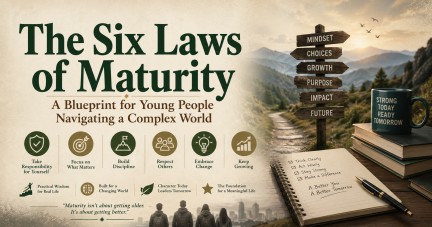

There is a dangerous misconception that maturity comes automatically with age, that simply surviving more birthdays somehow bestows wisdom, self-control, and clarity of purpose. Nothing could be further from the truth.
Walk into any room of fifty-year-olds and you will find people who still react like teenagers, who blame the world for their misfortunes, who chase approval like oxygen, and who have never once asked themselves what they actually stand for. Conversely, meet a twenty-two-year-old who has endured loss, taken radical responsibility for their life, and chosen integrity over comfort, and you will encounter someone far more mature than most people twice their age.
Maturity, as the psychologist Lawrence Kohlberg observed through his six stages of moral development, is not a biological inevitability but a psychological and moral achievement. It is the gradual, often painful process of learning to respond rather than react, to choose wisely rather than impulsively, and to build a life that reflects your deepest values rather than the shallow expectations of others.
The Six Laws of Maturity presented here are not abstract philosophies for monks and philosophers. They are practical, battle-tested principles for anyone, especially young people, who wants to navigate the chaos of modern life with clarity, purpose, and inner strength. These laws are:
1. The Law of Self-Mastery Control your mind, emotions, and actions.
2. The Law of Purpose Live with a clear purpose, not for applause.
3. The Law of Discipline Discipline today, freedom tomorrow.
4. The Law of Detachment Let go of what drains you. Focus on what builds you.
5. The Law of Continuous Growth Never stop learning, never stop evolving.
6. The Law of Integrity Choose honesty over convenience. Always.
Law 1: The Law of Self-Mastery
Control your mind, emotions, and actions.
The Foundation of All Growth
Self-mastery is the cornerstone upon which every other law rests. Without the ability to govern your own mind, emotions, and actions, you are at the mercy of every passing impulse, every external opinion, and every emotional wave that crashes over you.
Think of self-mastery as the internal architecture of your life. Just as a building requires a solid foundation to withstand storms, your life requires internal stability to withstand the inevitable chaos of existence. The person who masters themselves will find it easier to influence others and shape their own fate. Success in any domain involves overcoming personal weaknesses, while failure results from being overwhelmed by them.
What Self-Mastery Actually Looks Like
Self-mastery is not about becoming emotionless or robotic. It is about developing the capacity to observe your emotions without being controlled by them. It is the space between stimulus and response, and in that space lies your freedom.
Consider a young professional who receives harsh criticism from a manager. The immature response is immediate defensiveness, anger, or self-pity. The self-mastered response is to pause, breathe, assess whether the criticism has merit, and respond thoughtfully rather than reactively. This is what emotional regulation looks like in practice.
Self-mastery shows up in:
Your words speaking with intention rather than impulsively
Your reactions choosing responses rather than being hijacked by emotions
Your habits building routines that serve you rather than enslave you
Your decisions making choices aligned with your values, not your fleeting desires
The Young Person’s Challenge
For young people, self-mastery is particularly challenging because the world is constantly telling you who to be. Social media algorithms feed you content designed to trigger emotional reactions. Peer pressure whispers that you need to fit in. The culture of instant gratification tells you that you deserve everything right now.
Self-mastery is the rebellion against all of this. It is the declaration that you will not be a puppet of external forces. It is the quiet, daily work of building an internal compass that points true north regardless of the cultural weather.
Practical Steps Toward Self-Mastery
Start your day with intention. Before checking your phone, spend five minutes in silence. Set an intention for how you want to show up.
Practice the pause. When you feel a strong emotional reaction, force yourself to wait. Count to ten. Breathe. Ask yourself: “Is this reaction serving me?”
Keep a journal. Write down your triggers, your patterns, and your progress. Self-awareness is the bedrock of self-mastery.
Develop a morning routine. The first hour of your day sets the tone for everything that follows.
Law 2: The Law of Purpose
Live with a clear purpose, not for applause.
The Trap of External Validation
One of the great tragedies of modern life is the substitution of purpose for approval. Young people grow up in a world where likes, shares, comments, and followers have become currencies of self-worth. The result is a generation that knows how to perform for an audience but has no idea what they actually want when no one is watching.
The Law of Purpose cuts through this confusion with a radical proposition: your life is not about being liked. It is about being useful. It is about finding what only you can contribute and dedicating yourself to that contribution, regardless of whether anyone applauds.
Purpose Precedes Creation
There is a foundational principle that everything exists to fulfill a purpose. Purpose precedes creation. Nothing in the universe was created without a reason. Everyone and everything serves a purpose. You are not here by accident. You are here for a reason, and discovering that reason is the most important work of your life.
Purpose is not a lofty concept reserved for saints and visionaries. It is a practical, guiding principle that helps you make meaningful decisions, overcome challenges, and live a life of fulfillment. Purpose is the filter through which you evaluate every opportunity, every relationship, and every investment of your time and energy.
Purpose vs. Applause
The distinction between living for purpose and living for applause is the difference between a life of meaning and a life of exhaustion.
When you live for applause:
You are constantly anxious about what others think
Your self-worth rises and falls with external validation
You say yes to things that don’t align with your values
You are terrified of being seen as a failure
You never feel like you are enough
When you live for purpose:
You have an internal anchor that stabilizes you
Criticism doesn’t devastate you because you know your “why”
You say no to things that don’t serve your mission
Failure is just feedback, not a verdict on your worth
You experience deep fulfillment regardless of external recognition
Finding Your Purpose
Purpose is not something you discover overnight. It is something you uncover through exploration, experimentation, and reflection. Here is how to begin:
Ask yourself the hard questions. What problems do you care about solving? What would you do if money were not an issue? What do you want your life to stand for?
Pay attention to what energizes you. Purpose is often found at the intersection of what you are good at, what you love, and what the world needs.
Stop waiting for permission. No one is going to hand you your purpose. You have to claim it.
Start small. Purpose does not have to be grand. It can be as simple as committing to be the best version of yourself in your current role.
The greatest tragedy in life is not death, but a life without a purpose. Do not let that be your story.
Law 3: The Law of Discipline
Discipline today, freedom tomorrow.
The Paradox of Freedom
There is a profound paradox at the heart of human experience: the path to freedom runs through discipline. It seems counterintuitive. Discipline sounds like restriction, like rules, like doing things you do not want to do. Freedom sounds like doing whatever you want, whenever you want.
But this is a fundamental misunderstanding of both concepts. True freedom is not the absence of constraints. It is the ability to choose your constraints wisely so that you can live the life you actually want.
The person who cannot say no to junk food is not free. They are a slave to their cravings. The person who cannot put down their phone is not free. They are a slave to their algorithms. The person who cannot save money is not free. They are a slave to their impulses. Discipline is not the enemy of freedom. It is how you stop your impulses from stealing it.
Discipline as Investment
Think of discipline as an investment in your future self. Every time you choose the hard thing now, waking up early, working out when you are tired, studying when you would rather scroll, saving when you would rather spend, you are purchasing freedom for tomorrow.
Discipline today means:
Financial freedom tomorrow (because you saved and invested)
Physical freedom tomorrow (because you exercised and ate well)
Mental freedom tomorrow (because you studied and grew)
Emotional freedom tomorrow (because you practiced patience and self-control)
The alternative is also an investment, but a terrible one. Indulgence today purchases suffering tomorrow. Laziness today purchases regret tomorrow. As Jim Rohn wisely observed, leaders face two pains: the discipline of today or the regret of tomorrow. Choose your pain wisely.
What Discipline Actually Looks Like
Discipline is not about being a robot or denying yourself all pleasure. It is about strategic self-denial. It is about saying no to the good so you can say yes to the great.
Discipline looks like:
Showing up even when you do not feel like it
Finishing what you start even when the novelty has worn off
Keeping your word even when it is inconvenient
Delaying gratification even when instant pleasure is available
Sticking to your principles even when no one is watching
The Young Person’s Advantage
Young people have a tremendous advantage when it comes to discipline: time. The habits you build in your twenties compound like interest. A small daily investment in your health, your skills, your relationships, and your character grows exponentially over decades.
Start now. Today. Not tomorrow. The discipline you practice today creates the freedom you will enjoy tomorrow. Every empire begins with self-control. Your empire, your life, your legacy, your impact, begins with the small choices you make right now.
Law 4: The Law of Detachment
Let go of what drains you. Focus on what builds you.
The Weight We Carry
One of the most misunderstood aspects of maturity is the art of letting go. Many people confuse detachment with indifference or apathy. They think detachment means not caring. This is a profound error.
Detachment is not about caring less. It is about clinging less. It is the difference between holding something gently in your open hand and gripping it so tightly that your knuckles turn white. The tighter we grip, the more we suffer. Detachment is the practice of caring deeply while clinging lightly.
What Drains You?
The Law of Detachment requires honest self-assessment. You cannot let go of what you refuse to acknowledge. Take an inventory of your life:
What drains your energy?
Toxic relationships that leave you exhausted
Grudges you are carrying against people who have wronged you
Expectations you have placed on others that they cannot or will not meet
Material possessions that require more maintenance than they provide joy
Goals you are pursuing because someone else told you to
A version of yourself you are performing for an audience
What builds you up?
Relationships that energize and challenge you
Activities that put you in a state of flow
Goals that align with your deepest values
Practices that ground and center you
People who see you clearly and love you anyway
Maturity is the ongoing process of pruning what drains you and nurturing what builds you.
The Freedom of Letting Go
Letting go does not weaken you. It frees you. It clears the mental space you need for new opportunities, healthier relationships, and deeper wisdom. When you detach from outcomes, you open yourself to possibilities you could not have imagined.
The benefits of practicing detachment are profound:
Less anxiety and worrying
Less disappointment when things do not go as planned
Better health and well-being (since stress damages the immune system)
Greater emotional resilience
Freedom from over-identification with roles and titles
Practical Detachment
How do you practice detachment in daily life?
Release expectations of others. Allow people to be who they are. Do not make your happiness contingent on their behavior.
Forgive, not for them, for you. Grudges are poison you drink hoping the other person will die.
Let go of the need to control outcomes. Do your best, then release the result.
Practice gratitude. When you appreciate what you have, you are less attached to what you do not have.
Stop overthinking. Detach from painful outcomes by refusing to rehearse worst-case scenarios.
Law 5: The Law of Continuous Growth
Never stop learning, never stop evolving.
The Stagnation Trap
There is a seductive comfort in stagnation. It feels safe to stop growing, to settle into familiar patterns, to declare yourself “done” and coast through the rest of your life. But comfort is a trap. The moment you stop growing, you start dying, not physically, but spiritually, intellectually, and emotionally.
The Law of Continuous Growth is a declaration that life is a process of development, and developing is living. This process is not simply a spontaneous unfolding of latent potentialities. It requires intentional effort and engagement with the world. The value of the process of transformation lies in its continued enhancement of the quality of living.
Growth Is Not Automatic
One of the most dangerous myths is that experience automatically produces growth. It does not. You can have a great deal of experience and be no smarter for all the things you have done, seen, and heard. Growth requires reflection, intentionality, and a willingness to be uncomfortable.
Continuous growth means:
Always making your learning greater than your experience
Seeking new knowledge and being open to growth throughout your life
Staying curious and questioning intellectual certainty
Learning from failures as much as from successes
The Growth Mindset
Carol Dweck’s research on mindset is instructive here. People with a fixed mindset believe their abilities are static. You are either smart or not, talented or not, successful or not. People with a growth mindset believe their abilities can be developed through effort, learning, and persistence.
Maturity demands a growth mindset. The mature person understands that they are a work in progress. They are not threatened by feedback because they see it as fuel for improvement. They are not embarrassed by ignorance because they see it as an opportunity to learn. They are not defeated by failure because they see it as a stepping stone.
Growth in Practice
How do you embed continuous growth into your daily life?
Read widely. Books are the accumulated wisdom of humanity. Read outside your comfort zone.
Seek feedback. Ask people who know you well: “What is one thing I could do better?”
Embrace discomfort. Growth happens at the edge of your comfort zone. If you are comfortable, you are not growing.
Learn a new skill. Every year, commit to learning something that intimidates you.
Reflect regularly. What did you learn this week? This month? This year?
Surround yourself with people who challenge you. Iron sharpens iron.
The more you learn, the more opportunities you will create for yourself. Never stop learning, never stop evolving. The day you think you have arrived is the day you begin to decline.
Law 6: The Law of Integrity
Choose honesty over convenience. Always.
The Easy Path and the Right Path
Integrity is the quality that separates the mature from the merely aged. It is the willingness to choose what is right over what is easy, what is honest over what is convenient, what is true over what is comfortable.
The world will constantly present you with opportunities to compromise. A small lie here. A corner cut there. A principle bent just a little. The temptation is always to take the path of least resistance, to do what is expedient rather than what is honorable.
But integrity is not about the big, dramatic moments. It is about the small, everyday decisions that accumulate into a life. Integrity is built in the quiet moments when no one is watching.
Integrity Is Not Optional
Some people treat integrity as a nice-to-have, a luxury for those who can afford it. This is a dangerous delusion. Integrity is not optional. It is the foundation upon which everything else is built.
Integrity in your early years creates the foundation for authentic success in your middle years, enabling meaningful impact in your senior years. The reverse is equally true. Compromises in your twenties create a house of cards that will collapse in your forties.
Integrity is about:
Honoring your word doing what you said you would do
Standing by your conscience even when it costs you
Being honest with yourself and others about your motives and ends
Acting on your stated commitments even when doing so runs counter to your self-interest
The Cost of Convenience
Convenience is seductive. It whispers that just this once, it will be fine. It promises that no one will know. It assures you that the ends justify the means.
But convenience has a hidden cost. Every time you choose convenience over integrity, you erode something essential. You erode your self-respect. You erode others’ trust in you. You erode the internal compass that tells you right from wrong.
The Law of Integrity demands that you reject this bargain. Choose honesty over convenience. Always. Not sometimes. Not when it is easy. Always.
Integrity in Action
What does integrity look like in daily life?
In your words: Speaking truthfully, even when a lie would be easier
In your work: Doing quality work, even when no one is checking
In your relationships: Being the same person in private as you are in public
In your finances: Paying what you owe, even when you could get away with not paying
In your commitments: Following through, even when you have changed your mind