
Trump's Venezuela Raid: America First or Intervention?
GLOBAL AFFAIRS, POLITICAL ECONOMY, GOVERNANCE & INSTITUTIONSPOLITICS
Chaifry
1/5/20264 min read
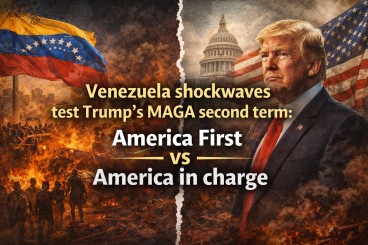
Venezuela shockwaves test Trump's MAGA second term: America First vs America in charge
Chaifry | News Analysis
President Donald Trump's decision to seize Venezuelan leader Nicolas Maduro in a U.S. military raid is quickly becoming more than a Latin America story. It is an early test of Trump's second term "Make America Great Again" (MAGA) vision: whether America First is mainly about pulling back from global commitments, or about using force to shape outcomes when Washington believes the payoff is high.
Maduro is expected to appear in Manhattan federal court on narco-terrorism charges after being transferred to custody in New York, according to U.S. officials and major international reporting. The operation has also triggered a legality debate at the United Nations, sharp reactions from rival powers, and careful, sometimes ambiguous, language from U.S. partners who want to preserve relations with Washington without endorsing a precedent they may later regret.
At home, Trump's allies are calling the raid decisive and long overdue. Abroad, many governments and legal experts are warning about precedent: a head of state captured by a foreign military without UN authorization or Venezuelan consent. That divide in framing will shape the next phase, from sanctions and oil policy to any international effort to recognize a successor government.
A raid, a courtroom, and a sovereignty fight
U.S. prosecutors accuse Maduro of overseeing a cocaine trafficking enterprise tied to state power. The case is now intertwined with the method of capture, raising immediate questions about sovereignty and the boundary between law enforcement and regime change.
At the United Nations, officials and legal experts cited in international coverage argued the operation lacks a clear lawful basis under the UN Charter absent Security Council authorization, Venezuelan consent, or a valid self-defense claim. China condemned the raid as a violation of non-interference, while the Vatican urged respect for Venezuelan independence and constitutional order.
Even in capitals that have long criticized Maduro's rule, officials are watching for a clear transition pathway. The practical concern is that removing a leader by force can produce a vacuum, and vacuums tend to be filled by armed factions, black-market power brokers, or external patrons.
Trump's message: control, speed, leverage
Trump has projected control. In remarks carried by U.S. media, he suggested the United States would temporarily "run" Venezuela. Secretary of State Marco Rubio later sought to narrow that message, saying Washington would not govern Venezuela day to day.
The administration's preferred frame is a short intervention designed to force a political reset while retaining leverage over Venezuela's key asset: oil. That matters domestically: if energy leverage reduces price pressure or strengthens U.S. bargaining power, the raid can be presented as an economic-security win.
But the more the U.S. is seen as owning the transition, the harder it becomes to argue this is not an open-ended responsibility. Once Washington is judged as the actor that changed the government, it can be blamed for what follows.
Why this hits MAGA's vision directly
Trump's second term opened with high-profile moves away from multilateral frameworks, including executive actions directing withdrawal from the World Health Organization and ordering an America First posture in international environmental agreements tied to the Paris Agreement framework.
Those steps fit a familiar MAGA premise: reduce external constraints, stop paying for systems seen as ineffective, and focus on domestic priorities. Venezuela points the other way. It is intervention, not withdrawal, and it risks pulling the administration into the kind of prolonged crisis management MAGA voters often reject unless Washington can show a fast handoff.
That is the tension inside MAGA's foreign policy vision. It wants maximum freedom of action without inheriting the cost, complexity, and political drag of long stabilization missions. Venezuela will show whether that balance is achievable.
The administration's bet: a short intervention with big domestic upside
The White House bet is that Maduro's removal can be sold as a law-enforcement success with a limited U.S. footprint. A workable transitional arrangement in Caracas, combined with control over key financial and energy levers, would allow Trump to argue that America First means selective force used quickly, with clear results.
If that story holds, the operation could reinforce core MAGA themes on drugs, migration pressures, and energy security. It would also signal to other leaders in the region that Washington is willing to escalate when it believes U.S. interests are directly affected.
However, speed cuts both ways. A fast intervention can outperform slow diplomacy, but it also leaves less time to build coalitions, secure legal cover, and pre-position humanitarian and stabilization plans.
The risk: mission creep and a legitimacy deficit
The worst case is mission creep. A contested transition could create pressure for U.S. protection of infrastructure, humanitarian corridors, repeated strikes, or a sustained security presence. Rival powers could deepen support to competing factions, prolonging the crisis and raising the risk of proxy escalation.
There is also the legitimacy problem. The UN debate is centered on legality and precedent. Even allies that avoid direct condemnation may hedge if Washington is seen as operating outside shared rules, while rivals use the episode to justify their own unilateral actions. Over time, that can reduce U.S. influence in the very forums it may still need for sanctions enforcement, refugee coordination, and regional security cooperation.
What to watch next
Four near-term indicators will show which way this goes:
Footprint and duration: weeks versus months, and whether U.S. involvement expands beyond the initial raid. A growing footprint would shift the operation from an extraction to a de facto stabilization mission.
UN and allied positioning: whether criticism hardens into coordinated diplomatic pushback or stays largely rhetorical. Formal actions, not statements, will matter most: votes, resolutions, and enforcement cooperation.
Transition stability in Caracas: whether authority consolidates and violence remains contained. A calm transition supports the White House narrative; fragmentation raises the likelihood of U.S. re-engagement.
Oil and sanctions choreography: whether energy leverage produces political outcomes without destabilizing markets. If volatility rises, any domestic political benefit could be offset quickly.
Bottom line
Trump's MAGA agenda has emphasized sovereignty, bargaining, and domestic control. The Venezuela raid adds a sharper edge: using force to reorder outcomes rather than renegotiating terms.
If the administration keeps the episode short and secures a credible political transition, Trump can market Venezuela as proof that MAGA delivers fast, concrete results. If the operation expands or the legality backlash hardens into sustained resistance, it could become the moment America First collides with the burdens of being America in charge.
Sources
Reuters reporting (Jan. 2026) on Maduro's transfer to U.S. custody, UN reaction, and statements from China and the Vatican.
Associated Press reporting (Jan. 2026) on U.S. administration statements about temporary control and oil leverage, and on interim political arrangements in Caracas.
Federal Register: Executive Order 14155 (WHO withdrawal) and Executive Order 14162 (America First in international environmental agreements), dated Jan. 20, 2025.