
Caracas Explosions & Iran Protests: An Analysis
GLOBAL AFFAIRS, POLITICAL ECONOMY, GOVERNANCE & INSTITUTIONSPOLITICS
Chaifry
1/3/202610 min read
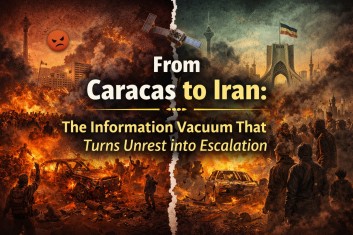
From Caracas to Iran: The Information Vacuum That Turns Unrest into Escalation
Two January 2026 case stories on misinformation, misgovernance, and a practical playbook for information integrity in good governance, public service reform, and security sector reform
A preventable share of modern escalation is not “strategy” in the classic sense. It is mismanaged uncertainty: incomplete facts in the first hours after a shock event, competing claims that harden before verification, and decisions taken under pressure with shrinking room for correction.
This article uses two January 2026 case stories—Caracas (3 January 2026) and Iran (2 January 2026)—to show how an information vacuum can become an accelerant. In Caracas, reports of explosions and aircraft activity were followed by competing claims and circulating social media footage that major outlets noted was not independently verified at the time. In Iran, demonstrations driven by economic distress coincided with sharp external threat narratives and heightened risks of manipulation. The shared lesson is practical: good governance and security sector reform cannot treat information management as after-the-fact messaging. It is an operational control. The article offers a Minimum Viable Information Governance (MVIG) playbook—verification lanes, minimum viable disclosure, decision logs, ethical social listening, authenticity triage, and grievance closure loops—paired with a simple Monitoring and Evaluation indicator set designed to keep decision space open and reduce escalation risk.
1. Why Caracas and Iran belong in the same governance analysis
Caracas and Iran are not the same setting. Their drivers of instability differ, institutional capacities vary, and geopolitical stakes are distinct. What makes them analytically useful side-by-side is the information pattern: the first hours and days after a shock create a vacuum. If the vacuum is not filled with verified disclosure, it is filled by fast narratives—some honest, some mistaken, some manipulated—amplified by platform mechanics and by political incentives.
Once a narrative locks in, decision space shrinks. Leaders fear the reputational cost of revising a position. Agencies respond to public pressure rather than verified facts. Security institutions move into “tempo mode,” where speed becomes a substitute for certainty. Later corrections may arrive, but the damage is already priced into behaviour: panic buying, street mobilisation, targeted reprisals, hurried deployments, and diplomatic signalling that is hard to unwind.
This is not a communications problem. It is a governance problem with direct SSR consequences. When state institutions cannot communicate verified facts, people outsource belief to the loudest node in their network. That shift weakens legitimacy and increases the likelihood of blunt, coercive, and politically costly responses.
International guidance has started to treat this as a systemic risk. The United Nations’ Global Principles for Information Integrity argue that misinformation and disinformation can now spread at unprecedented volume and velocity, and that coordinated action is required across states, platforms, media, and civil society. The OECD’s work on information integrity similarly links disinformation to weakened trust, distorted policy choices, and institutional fragility. The practical conclusion is straightforward: “information integrity” belongs inside crisis management, public administration, and security governance—treated as routine, measurable practice.
1. Case story A: Caracas, 3 January 2026 — early attribution, high stakes
2.1 What was reported
On 3 January 2026, multiple explosions were reported in Caracas alongside aircraft activity, black smoke, and a power disruption in the southern area near a major military base. Reuters reported that the cause of the disturbances was unclear at the time and noted that videos circulating on social media had not been independently verified. Associated Press reported that Venezuela’s government accused the United States of attacks on civilian and military sites across multiple states, including the capital, and that President Nicolás Maduro announced national defence measures and a state of “external disturbance.”
A Caracas-style incident is a classic high-risk information moment: an unfolding event, incomplete confirmation, intense geopolitical incentives, and strong emotional arousal. Under these conditions, the first story that “feels true” spreads faster than the story that is verifiable.
2.2 The information vacuum in practice
Three dynamics routinely appear in the first six to twelve hours of incidents like this.
First, demand for certainty outpaces the ability to verify. A state may not have confirmed what hit what, from where, and with what effect. Media cycles and social feeds will not wait. Silence becomes an information product, interpreted as concealment, incapacity, or complicity.
Second, “evidence” becomes a weapon. Short clips, photos without metadata, recycled footage, and edited audio can appear persuasive. Even when later debunked, the first impression tends to stick. This is why major outlets explicitly flag “unverified videos” in breaking coverage: the audience must be reminded that virality is not verification.
Third, influential posts internationalise uncertainty. Once prominent officials or major influencers amplify a claim, the story crosses borders and becomes a diplomatic issue before domestic verification is complete. Attribution—whether accurate or not—can then shape military posture, retaliatory logic, and public expectation.
2.3 Governance and SSR risk points
In strike-claim environments, governance failure rarely looks like one dramatic mistake. It is the accumulation of small, predictable gaps:
a first statement that over-claims certainty, or refuses to acknowledge uncertainty
inconsistent messaging across ministries and security agencies
no published verification rhythm (what will be checked, by whom, and when the public will be updated)
reactive “control” measures (shutdowns, mass detentions, sweeping emergency language) that deepen distrust if later facts differ
security actions taken without traceable authorisation and review, creating accountability gaps and future grievance spikes
The Caracas lesson is simple: the earliest governance action is not a deployment. It is a verification and disclosure routine that protects decision space.
3. Case story B: Iran, 2 January 2026 — protest dynamics under threat narratives
3.1 What was reported
On 2 January 2026, Reuters reported deadly unrest in Iran linked to economic distress, with demonstrations spreading and arrests reported. Reuters also reported that U.S. President Donald Trump threatened possible military intervention to support protesters if security forces attacked demonstrators, and that Iranian officials warned against foreign interference. Associated Press described protests driven by economic hardship and currency collapse, alongside escalating rhetoric between Washington and Tehran.
This is a different trigger from Caracas, but the information hazard is similar: compressed time, high emotion, competing incentives to escalate, and a global audience ready to interpret events through existing geopolitical frames.
3.2 How information disorder enters protest settings
Protest environments generate predictable information problems:
inflated casualty and arrest numbers shared rapidly without verification
misattributed or recycled videos presented as “today in City X”
deliberate provocation content designed to trigger fear, retaliation, or harsher security response
impersonation and false “official statements” circulated to create confusion about curfews, border closures, bank limits, or imminent violence
External threat narratives intensify these risks. When a foreign leader signals possible intervention, parts of the protest movement may read it as support. State institutions may treat it as justification for harsher controls. This dynamic reduces space for de-escalation, multiplies propaganda incentives, and raises the probability of miscalculation.
3.3 Synthetic media as an accelerant
Synthetic media now changes the speed and credibility profile of manipulation. During the 2025 Israel–Iran conflict, fact-checkers documented AI-generated videos and fabricated clips falsely presented as real war damage and official messaging. In parallel, the UN’s International Telecommunication Union urged stronger measures to detect deepfakes and recommended digital verification tools and standards to limit manipulation and associated harms.
Even when protests are the trigger, synthetic media can become the accelerant—especially if it “proves” a crackdown, an atrocity, or foreign intervention. The operational implication is uncomfortable but necessary: institutions must assume that plausible fake video and audio will appear early, often before internal verification is complete.
4. The shared mechanism: the escalation pipeline
Across both case stories, the pathway is similar.
Stage 1 — Ambiguity shock: high-impact event with contested facts.
Stage 2 — Narrative capture: a storyline “wins” before verification.
Stage 3 — Decision compression: leaders and agencies act under time and audience pressure.
Stage 4 — Institutional lock-in: reversing course becomes politically costly.
Stage 5 — Escalation by signalling: deterrence moves are misread; local triggers become strategic crises.
The objective is not perfect prediction. The objective is to interrupt the pipeline early—while facts are still uncertain and positions are still reversible.
5. Minimum Viable Information Governance (MVIG): a practical playbook
MVIG is the smallest set of routines that helps institutions convert uncertainty into verified public decisions without manufacturing certainty. It is designed for fragile settings where capacity is limited and trust is uneven. It is also designed to be compatible with rights and oversight, avoiding censorship traps.
5.1 Joint Verification Lane (JVL)
A JVL is a standing mechanism with chairing authority, membership, and a standard output: a one-page “verification note” that separates:
confirmed facts
credible but unconfirmed claims
items being checked (and by whom)
key unknowns and evidence gaps
The note is time-stamped and updated on a predictable rhythm. This routine does not slow response; it reduces error-driven escalation and reduces the temptation to “announce certainty” for reassurance.
5.2 Minimum Viable Disclosure (MVD)
An MVD statement prevents the vacuum. It is a short first statement that does not over-claim. It must contain:
what is confirmed
what is not yet confirmed
what verification steps are underway
when the next update will be issued
clear public safety guidance
In both Caracas and Iran-style incidents, MVD is a legitimacy tool. It signals competence and reduces space for malicious substitution.
5.3 Crisis communications discipline (two-tier protocol)
Tier 1 (first hour): facts only, verification underway, next update time.
Tier 2 (after verification note): context, posture, and decisions, clearly tied to verified elements.
This avoids the most common failure mode: premature attribution, followed by backtracking that destroys credibility.
5.4 Ethical social listening and “rumour + search” monitoring
Early warning is visible in the information environment. The goal is not surveillance of citizens. The goal is to detect fast-moving falsehoods that create harm. The World Health Organization has published ethical guidance on social listening for infodemic management, including rights-respecting principles, safeguards, and practical governance arrangements. The same approach applies to civic unrest: monitor topics and velocity proxies, not personal identities; aggregate signals; and establish clear access controls and oversight.
A basic dashboard should track:
breakout topics (what is suddenly spiking)
location references (where the rumour is “landing”)
harm cues (calls to violence, targeting, panic triggers)
reach proxies and velocity proxies
a simple RAG trigger set tied to response actions
5.5 Decision logs and authorisation hygiene (security sector focus)
Security institutions should treat communication and authorisation as operational controls:
a one-page decision log for high-risk incidents (what decision, by whom, based on what verified information)
authorisation fields for forceful measures (legal review and senior approval thresholds)
after-action review when any “red” threshold is met
This supports SSR by making actions reviewable and learning-oriented rather than purely reactive. It also protects leadership by creating an evidence trail that resists later narrative manipulation.
5.6 Corrections that land: trusted messengers and closure loops
Corrections fail when issued by institutions that are not credible to the audiences that believe the rumour. MVIG uses a simple “trusted messenger map”:
who is trusted by which constituencies
which channels reach them (radio, WhatsApp groups, community leaders, local media)
what language reduces defensiveness and increases uptake
Corrections also require closure. A rumour correction without an accountability or grievance path is experienced as denial. Public service reform tools—grievance mechanisms with clear timetables, documented outcomes, and protection of complainants—are part of information integrity.
5.7 FIMI-aware mapping
Foreign information manipulation and interference (FIMI) is a useful lens when narratives show coordination. The EU’s work on FIMI provides behavioural and technical indicators and analytical tools for mapping operations, including attention to the infrastructure used for manipulation. In practice, MVIG does not require sophisticated intelligence. It requires routine mapping of:
repeated amplification nodes
coordinated timing across accounts
recycled narratives across platforms
abnormal bot-like spread patterns
The point is not to label everything “foreign.” The point is to detect coordination early enough to protect civic space and prevent escalation.
5.8 Authenticity and provenance: Content Credentials as an institutional routine
Because synthetic media will not disappear, verification must evolve. The Coalition for Content Provenance and Authenticity (C2PA) provides an open technical standard—often implemented as “Content Credentials”—to attach tamper-evident provenance information to media. This does not “prove truth,” but it improves accountability: origin and edits become inspectable when credentials are present.
A pragmatic MVIG rule for agencies and partners:
preserve originals (do not forward screen-recorded copies as “evidence”)
store chain-of-custody for official footage and key citizen submissions
when possible, encourage use of provenance-capable tools for official comms teams and trusted monitors
treat missing credentials as neutral (not proof of falsity), but treat strong provenance as a positive verification signal
5.9 Deepfake triage
Synthetic audio and video must be treated like any other high-risk evidence. Minimal triage rules:
preserve the original file and source chain (no reshares)
check for provenance signals where available
corroborate with at least two independent sources (time, place, witnesses)
communicate uncertainty explicitly until verified
6. Monitoring and Evaluation: indicators and triggers that protect decision space
Monitoring and Evaluation is the switch that turns monitoring into early action. A compact indicator set is enough.
Verification performance
time-to-first MVD statement
time-to-first verification note
percentage of official statements that include confidence grading
Correction performance
correction latency
correction reach versus rumour reach (proxy)
percentage of corrections delivered through trusted messengers
Governance stress
grievance inflow versus closure rate
time-to-closure for priority complaints
consistency score across official channels (simple checklist)
Security integrity
authorisation compliance rate for high-risk actions
after-action review completion rate
SOP updates issued within 14 days when repeated failures occur
Harm outcomes
correlation between rumour spikes and offline incidents (panic buying, riots, reprisals)
service disruption days linked to misinformation bursts
RAG triggers (simple)
Green: stable rumour volume; corrections within 24–48 hours; no verified harm linkage.
Amber: rumour spikes; correction lag; rising grievances; early signs of offline mobilisation.
Red: verified harm linkage; contradictory official statements; high-risk deployments; violence or mass panic.
7. A pragmatic delivery offer (governance + SSR ready)
This series has been arguing for practical capability, not “communications theatre.” A minimal deliverable that can be funded and measured is an Information Integrity and Crisis Governance Unit, embedded inside the existing crisis architecture (cabinet office, interior ministry, or joint operations centre) with strong oversight.
Core outputs in 90 days
Joint Verification Lane and templates
Minimum Viable Disclosure protocol and training for spokespersons and duty officers
Rumour/search dashboard with RAG triggers and escalation rules
Decision logs for high-risk security actions
Basic deepfake triage and authenticity workflow
Institutionalisation in 12 months
SOP integration, drills, and refresher training
grievance closure standards with aggregate public reporting
quarterly learning cycles (after-action reviews that produce SOP updates within 14 days)
expanded provenance adoption for official content and trusted monitoring where feasible
8. Why this is a peacebuilding tool
When people believe institutions can tell the truth, correct fast, and close the loop on grievances, mobilisation becomes less brittle and security responses become more proportionate. MVIG belongs in:
security sector reform (oversight, authorisation, review)
public service reform (service continuity, grievance resolution)
good governance (transparency, accountability, trust)
Caracas and Iran show the cost of delay: once the narrative space is captured, de-escalation becomes harder even for actors who want it.
Annex: Search-intent keyword clusters (rotate by platform; avoid stuffing)
Caracas / Venezuela cluster
Caracas explosions; Caracas bombing; Venezuela attacks; Venezuela military base; Fuerte Tiuna; La Carlota; power outage Caracas; Maduro national defence; U.S.–Venezuela tensions; sanctions; disinformation Venezuela; WhatsApp rumours; OSINT verification Caracas.
Iran cluster
Iran protests 2026; Iran unrest; rial collapse; inflation Iran; Pezeshkian; crackdown rumours; intervention threats; U.S.–Iran tensions; disinformation Iran; Telegram misinformation; deepfake Iran; voice cloning; digital verification; watermarking; AI-generated videos.
Cross-cutting governance terms
information integrity; misinformation; disinformation; harmful information; crisis communications; public order; early warning; social listening; platform accountability; recommender systems; deepfake detection; content provenance; Content Credentials; C2PA; FIMI; hybrid threats; Monitoring and Evaluation indicators; grievance redress.
References:
Reuters and Associated Press reporting on Caracas explosions and competing claims (3 January 2026).
Reuters and Associated Press reporting on Iran protests and intervention threat narratives (2 January 2026).
United Nations: Global Principles for Information Integrity (June 2024).
OECD: Facts Not Fakes—Tackling Disinformation, Strengthening Information Integrity.
EEAS: 3rd Report on Foreign Information Manipulation and Interference (March 2025).
ICRC: Addressing Harmful Information in Conflict Settings (January 2025).
WHO: Social listening in infodemic management—ethical considerations (2025).
ITU/UN report (via Reuters): measures to detect AI-driven deepfakes and the case for standards (2025).
C2PA: Content provenance and “Content Credentials” open standard.