
Mukalla Port Strike: Saudi-UAE Tensions in Yemen
GLOBAL AFFAIRS, POLITICAL ECONOMY, GOVERNANCE & INSTITUTIONSPOLITICS
Chaifry
12/31/20258 min read
From Misinformation to Misgovernance: How Avoidable Conflict Gets Mismanaged
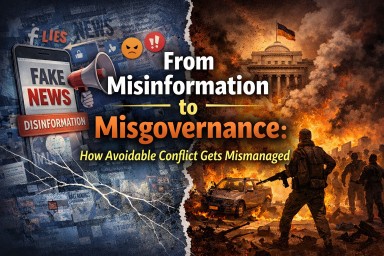
Lessons from the Saudi-UAE rupture in Yemen and the Mukalla port strike (December 2025)
The Mukalla port strike and the immediate diplomatic fallout between Saudi Arabia and the United Arab Emirates (UAE) is a case study in how information failure becomes governance failure. The core lesson is not that allies disagree or that rival Yemeni factions compete. Those realities are old. The lesson is that, when decision-makers stop trusting the same facts, crisis management slides into escalation management - and the costs are paid by civilians, institutions, and long-term political settlement prospects.
This episode moved from disputed logistics and shipping claims to kinetic action, ultimatums, and troop-withdrawal announcements within hours.
Competing narratives around cargo, authorization, and intent created a 'fact vacuum' where worst-case assumptions became policy.
In fragile contexts, information disorders thrive because verification systems are weak, incentives reward posturing, and accountability is thin.
Preventing avoidable escalation requires 'information governance' - shared verification, disciplined public communication, and rapid after-action learning - treated as core security infrastructure.
From an SSR and MEAL perspective, the fix is practical: minimum standards for deconfliction data, RAG thresholds for response, independent monitoring, and closure-focused grievance and oversight loops.
1. What happened in Mukalla and why it escalated
On 30 December 2025, a Saudi-led coalition airstrike hit Yemen's southern port of Mukalla. Riyadh framed the strike as targeting a shipment linked to foreign military support for the UAE-backed Southern Transitional Council (STC). The UAE rejected the weapons allegation and said the cargo was for Emirati forces, expressing surprise at the strike.
In parallel, Yemen's Saudi-backed presidential leadership issued a time-bound demand for UAE forces to leave. Within the same news cycle, the UAE announced it was ending the mission of its remaining counterterrorism personnel in Yemen.
A compressed timeline (as publicly reported)
Coalition strike on Mukalla port; Riyadh alleges UAE-linked support flows to southern separatists.
Yemen's Saudi-backed leadership issues an ultimatum for UAE forces to leave; internal Yemeni leadership divisions surface in public.
UAE says it is ending the mission of remaining counterterrorism units and disputes claims about the cargo's nature and destination.
Markets in the Gulf react negatively amid concerns that political friction could complicate wider regional coordination.
Why this was structurally combustible
The strike landed on top of an already shifting southern battlefield. In early December 2025, STC forces moved rapidly eastward across southern Yemen, including key areas in Hadramout, a governorate with strategic depth, resources, and proximity to borders. Saudi Arabia and the UAE have overlapping interests in countering the Houthis, but they have diverged over the desired political end-state in the south and over which local actors should hold coercive power.
2. From misinformation to misgovernance: the escalation pipeline
Conflicts are no longer triggered only by troop movements. They are triggered by narratives about troop movements, by claims about shipping manifests, by edited footage, by selective disclosures, and by rumor networks that travel faster than any joint verification process.
Misinformation, disinformation, and 'harmful information'
The UN has pushed for a focus on information integrity, warning that the spread of mis- and disinformation and hate speech undermines trust and accelerates instability. The ICRC uses 'harmful information' as a practical umbrella: any distorted, misleading, manipulated, or hateful information that can trigger harm for people affected by armed conflict.
In operational terms, the immediate question is not whether a narrative is morally offensive. It is whether it changes behavior: whether it triggers retaliation, constrains humanitarian movement, fuels recruitment, or pushes leaders into public positions they cannot later soften without losing face.
How the pipeline works
Ambiguity: An event occurs (for example, an arrival of vessels or cargo at a contested port) that is high-stakes but hard to verify quickly.
Narrative capture: Competing actors frame the event as proof of hostile intent and broadcast that framing to domestic audiences and allies.
Decision compression: Political and military leaders act under time pressure in a shrinking window, often with incomplete or partisan information.
Public commitment: Ultimatums and statements lock in positions. The cost of backing down rises sharply.
Institutional spillover: The dispute fractures command coordination and governance arrangements, creating new incentives for local spoilers.
The Mukalla episode reflects this pattern: disputed claims about cargo and authorization became the basis for kinetic action, followed by urgent political directives and a rapid strategic recalibration.
3. Misgovernance in practice: where systems failed
Misgovernance is not just corruption or incapacity. In crisis settings, it often shows up as a predictable set of system gaps: weak verification, unclear authority, poor communication discipline, and accountability that cannot keep up with events.
Five governance failures that make escalation more likely
No trusted joint verification lane: When partners do not share an evidence standard, every incident becomes a test of loyalty.
Deconfliction data is not treated as security infrastructure: Cargo clearance rules, chain-of-custody logs, and shared situational awareness are often informal or politicized.
Public communication outruns internal coordination: Statements designed for domestic audiences can sabotage coalition coordination and make compromise politically toxic.
Fragmented authority inside the host government: Competing orders and counter-orders, aired in public, signal weakness to armed actors and invite defiance.
Incentives reward maximalist framing: If each actor gains leverage by presenting events as existential threats, moderation becomes a losing strategy.
Fragility makes it worse
In fragile contexts, the system is exposed to shocks and lacks coping capacity. The OECD describes fragility as exposure to risk combined with insufficient capacities of the state, system, or communities to manage, absorb, or mitigate those risks. In Yemen's southern contest, that translates into institutions that cannot verify fast enough, cannot enforce rules consistently, and cannot maintain a single legitimate chain of command across competing armed networks.
4. An SSR and MEAL lens: how to stop managing the headline and start managing the risk
In security sector reform (SSR), the most dangerous moments are often not the big offensives. They are the small incidents that move faster than oversight - a shipment, an arrest, a checkpoint clash - because these incidents become symbols. As a monitoring, evaluation, and learning practitioner, I see the same pattern repeatedly: when feedback loops are slow, leaders act on partial signals; when accountability is weak, rumor fills the gap; and when governance cannot show 'closure', anger becomes organizing energy.
Minimum viable information governance (MVIG)
If you want to reduce avoidable conflict, you do not start with lofty statements. You start with a minimum viable system that makes escalation harder.
Joint Verification Cell: a standing technical team (coalition, host authorities, and a mutually accepted third party) that can validate time-sensitive claims within hours, not days.
Evidence standard: agreed proof requirements (photos, manifests, AIS records, custody chain) and a rule that public accusations must reference the evidence standard.
Deconfliction protocol for ports and corridors: explicit authorization steps, inspection windows, and 'red flag' triggers that pause movement until verified.
Public communications discipline: a shared template for rapid statements that acknowledge uncertainty without assigning intent until verified.
After-action learning: within 14 days, convert incident findings into updated SOPs and refresher drills (otherwise lessons die as rumors).
Early warning with RAG thresholds (practical, not academic)
Most conflict settings collect data that is too slow and too polite. A serious early warning system is high-frequency, messy, and honest.
Weekly public protection bulletin with simple Red-Amber-Green (RAG) thresholds for incidents, civilian harm risks, and movement restrictions.
Acknowledgement within 48 hours: confirm the incident occurred, state what is being verified, and publish when verification will be complete.
Red triggers require same-week action: independent inspection, joint site access, and a written decision log explaining why escalation was or was not chosen.
Rumor tracking is not a side project: treat spikes in specific narratives as leading indicators of violence and institutional fracture.
SIPRI's work on mis- and disinformation in peace operations echoes this: responses work best when communications is treated as a core operational function, paired with local understanding and rapid correction mechanisms.
5. The mismanagement problem: crisis response that produces more crisis
Once misgovernance sets the stage, mismanagement is what turns a political dispute into an operational spiral. The pattern is familiar: leaders act to 'restore control' but the act itself becomes a new grievance, new propaganda, and new justification for retaliation.
A practical playbook to reduce avoidable escalation
A) Accountability that closes the loop
Grievance handling with a 30-day closure deadline and published resolution rates at the local level.
Community witnesses for sensitive cases to reduce intimidation and increase legitimacy.
A short public note on disciplinary action taken (even when details must remain confidential).
B) Roster and payroll hygiene (because impunity often starts with ghost systems)
Biometric or HRMIS-linked payroll where feasible; payments routed through traceable channels.
Monthly payroll-inventory reconciliation and random spot checks.
Independent audits with published variances and time-bound corrective actions.
C) DDR as a contract, not a slogan
Tranche-based support tied to measurable improvements in local protection and basic services that hold for 60+ days.
Clear definitions of 'compliance' and 'breach' that are monitored by independent observers.
Local protection indicators (night travel resumes, markets extend hours, schools open reliably) treated as decisive evidence.
D) Local voice and monitoring that is safe and useful
Independent monitors paired with local enumerators to reduce blind spots.
Hotlines and citizen panels; rumor tracking integrated into routine reporting.
Fund two or three quick community fixes per quarter to show governance can deliver, not only punish.
E) Information integrity measures that work in conflict
The UN's Global Principles for Information Integrity provide a high-level frame for action, including transparency, accountability, and resilience-building. The ICRC's response framework emphasizes protecting civilians by designing practical responses to harmful information. In Yemen-like contexts, the operational translation is straightforward:
Separate verification from messaging: one lane verifies claims; another lane communicates what is known, unknown, and being done.
Publish 'what we can confirm' in plain language and update on a fixed schedule (silence is where rumor grows).
Do not amplify hostile narratives by repeating them without context; when correcting, lead with facts and consequences.
Protect local journalists and monitors; information integrity cannot exist where truth-tellers are unsafe.
6. What international partners should stop doing (and start doing)
Stop doing
Treating misinformation as a communications nuisance rather than a security risk.
Funding data systems that are 'beautiful' but slow, over-aggregated, and detached from decisions.
Assuming coalition partners will self-correct without incentives and verification mechanisms.
Start doing
Require deconfliction data standards in assistance agreements (authorization logs, inspection protocols, custody chains).
Fund independent monitoring and rapid verification capacity at ports and corridors.
Support high-frequency risk monitoring with simple RAG thresholds tied to clear decision rights.
Invest in 'learning that lives': after-action findings turned into SOP updates and drills within 14 days.
Measure legitimacy, not only territory: track grievance closure rates, civilian movement confidence, and service continuity.
Conclusion: avoidable conflict is often mismanaged uncertainty
The Mukalla strike episode is not just a Gulf rivalry story. It is an information integrity story with governance consequences. If leaders cannot share a baseline of verified facts, every contested incident becomes an excuse to reposition, punish, or pre-empt. In fragile environments, that logic is self-accelerating.
The remedy is not rhetorical restraint alone. It is institutional design: minimum viable information governance, disciplined communication, independent verification, and MEAL systems that are fast enough to shape decisions. The payoff is simple: fewer escalations driven by rumor, more credibility for governance, and more space for political settlement.
Sources
Reuters (30 Dec 2025). 'UAE vows to pull remaining forces from Yemen in crisis with Saudi Arabia.'
Reuters (30 Dec 2025). 'UAE says it ends mission of remaining forces in Yemen voluntarily.'
Associated Press (30 Dec 2025). 'Saudi Arabia bombs Yemen port city over weapons shipment from UAE for separatists.'
United Nations (24 Jun 2024). 'Global Principles for Information Integrity' (launch and principles).
Reuters (30 Dec 2025). 'Most Gulf markets retreat as Saudi and UAE clash over Yemen.'
OECD (Sep 2022). 'What is fragility?'
ICRC (2025). 'Addressing Harmful Information in Conflict Settings: A Response Framework for Humanitarian Organizations' and related explainer materials; plus ICRC Review article 'Liar's war' (2021).
SIPRI (2023). 'Tackling mis- and disinformation: Seven insights for UN peace operations.'
RUSI (Dec 2025). 'Southern Yemen’s Power Shift: the Houthis and the UAE-Saudi Rivalry.'
Al Jazeera (Dec 2025) and other reporting on STC advances in Hadramout and al-Mahra.
Appendix: source links
Reuters - Yemen strike shows depth of distrust between Saudi Arabia and UAE (30 Dec 2025)
Reuters - UAE vows to pull remaining forces from Yemen in crisis with Saudi Arabia (30 Dec 2025)
Reuters - UAE ends mission of remaining forces in Yemen (30 Dec 2025)
Reuters - Gulf markets retreat as Saudi and UAE clash over Yemen (30 Dec 2025)
AP - Saudi Arabia bombs Yemen port city over weapons shipment from UAE (30 Dec 2025)
UN - Global Principles for Information Integrity
UN press release PDF (24 Jun 2024)
OECD - What is fragility? (Sep 2022)
ICRC - Harmful information Q&A
ICRC - Response framework (30 Jan 2025)
ICRC Review - Liar's war (2021)
SIPRI - Seven insights for UN peace operations (2023)
RUSI - Southern Yemen’s Power Shift (Dec 2025)
Al Jazeera reporting on STC advances (Dec 2025)